





When to Use Fiber Optic Underground Cable?
Underground fiber optic cable deployment makes sense when reliability, longevity, and protection from environmental factors outweigh higher initial installation costs. Network operators typically choose underground installation for urban areas with aesthetic requirements, regions experiencing severe weather, high-security applications, and long-term infrastructure projects where reduced maintenance justifies upfront expenses.
Underground Deployment Delivers Superior Reliability
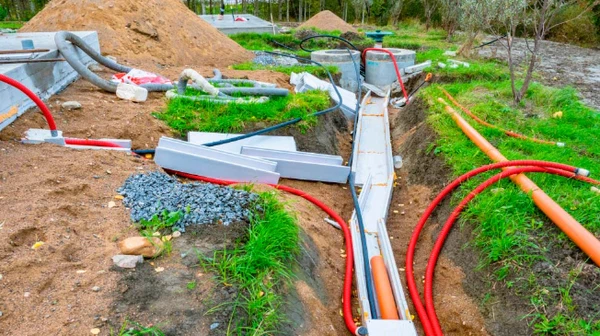
Buried fiber deployments offer approximately 10 times more reliability than aerial routes, particularly in areas with frequent severe weather. Underground cables remain immune to electromagnetic interference from lightning strikes and power surges that commonly disrupt copper-based systems. The physical protection provided by burial depth-typically 24 to 48 inches depending on location-shields cables from wind damage, ice accumulation, falling debris, and vehicle collisions that regularly affect overhead installations.
The underground fiber optic cable market reached $5.91 billion in 2024, driven by infrastructure supporting critical services including healthcare, transportation, and government operations. This growth reflects a clear industry preference for reliability over lower installation costs, especially as network downtime becomes increasingly expensive for businesses and essential services.
Weather resistance stands as a primary advantage. Underground cables are buried below the frost line, protecting them from freeze-thaw cycles that damage surface-level infrastructure. While extreme flooding can still pose risks, underground installations generally remain stable during hurricanes and severe storms, as demonstrated when Hurricane Irma battered Florida in 2017 and local fiber networks continued operating without major disruptions.
Installation Costs Reflect Long-Term Value
Underground fiber optic installation typically ranges from $1 to $6 per foot depending on fiber count, compared to significantly lower costs for aerial deployment. However, this comparison oversimplifies the economic calculation. Professional underground installations generally cost $15 to $35 per linear foot for basic deployments, with complex projects potentially exceeding $50 per foot when including specialized equipment and restoration work.
Several factors drive underground installation expenses higher. Excavation requires specialized equipment and skilled labor. Properties with steep terrain, established tree root systems, or rocky ground face additional challenges during underground deployment, substantially increasing labor costs and project complexity. Urban environments present their own obstacles-drilling through asphalt or concrete can cost ten times more than mole plowing or shallow trenching in rural settings.
The initial investment pays dividends through reduced maintenance requirements. Underground cables require less maintenance than aerial alternatives because environmental protection eliminates weather-related repairs and reduces outage frequency. Network operators avoid the ongoing expenses of repairing wind damage, replacing cables damaged by fallen trees, or addressing animal interference that plagues overhead installations.
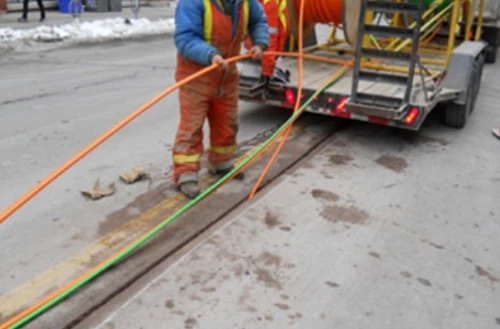
Micro-trenching has emerged as a cost-effective middle ground. This technique involves cutting a thin 20 to 40 millimeter wide slot just 100 millimeters deep in pavement, then stacking microducts within it. While offering faster deployment than traditional trenching, the shallow depth creates vulnerability during road resurfacing projects.
Municipal Requirements Often Mandate Underground Cable
Most local authorities and customers prefer fiber cables installed underground for aesthetic reasons and compliance with visual standards. Urban planning departments frequently require underground installation to eliminate visual clutter from utility poles and overhead cables. Historic districts, upscale residential developments, and downtown business areas typically prohibit aerial cables entirely.
Underground routes commanded 46.1% revenue share in the fiber optic cable market during 2024, reflecting municipal mandates for aesthetic streetscapes and resilience against weather events. This market dominance indicates that regulatory requirements and customer preferences increasingly favor underground deployment despite higher costs.
Permitting processes vary significantly by jurisdiction. Obtaining permits and easements for underground installations can be bureaucratic and time-intensive, potentially delaying project timelines. However, once permits are secured, underground installations often proceed more smoothly than aerial deployments that require utility pole attachment agreements and make-ready work involving multiple utility companies.
Security considerations reinforce the underground preference for government and military installations. Burying networks underground minimizes chances of unauthorized physical access, greatly reducing risks of intentional sabotage from hackers or malicious individuals attempting to disrupt communications or steal confidential data. Financial institutions, data centers, and critical infrastructure operators routinely specify underground deployment for this reason.
Terrain Geology Determines Installation Feasibility
The geology of a landscape directly determines whether buried or aerial fiber deployments are most suitable for the last-drop connection. Sandy soils offer ideal conditions for underground installation-they excavate easily by hand, allow operators to create flat trench bottoms, and provide good drainage. Rocky terrain presents the opposite scenario, dramatically increasing costs and potentially making underground deployment economically unviable.
In rocky terrain, cables must often be laid in shallow trenches, leaving them closer to the surface and more vulnerable to damage, which then requires more expensive armored cable that can withstand contact. Some Canadian regions, particularly areas with bedrock at the surface, find trenching almost infeasible, forcing operators toward aerial installations despite preference for underground deployment.
Clay soils require special consideration. Clay is harder to dig and can contain rocky particles that impinge on cables and ducts, causing damage after burial. Operators circumvent these challenges by digging deeper trenches and using thicker-walled cables or ducts, but these solutions increase project costs substantially.
Agricultural areas demand deeper burial depths. In rural or agricultural regions where farm equipment may dig deeper into soil, fiber optic cables should be buried at least 48 inches deep to avoid potential damage from plowing or other deep soil disruption activities. This extra depth requirement makes underground installation more expensive in farming regions, though the protection from agricultural equipment justifies the added cost.

Burial Depth Standards Ensure Adequate Protection
International standards specify minimum burial depths between 0.6 and 1.0 meters to ensure cables are protected from external damage and environmental influences. In the United States, NESC standards stipulate minimum burial depth of 0.9 meters under roads and 1.2 meters under railway lines. European standards follow similar patterns, with CENELEC requiring 0.8 meters in urban areas and 0.6 meters in suburban locations.
Practical implementation varies by location type. In urban areas where space is constrained, fiber optic cables may be buried at depths of 2 to 4 feet, typically inside protective conduits to guard against frequent construction or utility work. High-traffic areas including roads and railways require deeper burial, up to 5 feet, to avoid accidental damage from road construction or heavy machinery.
Frost line considerations influence northern climate installations. Cables must be buried below the layer where soil freezes to prevent damage from ground movement during freeze-thaw cycles. In colder regions, this requirement can push burial depths to 48 inches or more, adding to excavation costs but ensuring year-round cable integrity.
Conduit use affects depth requirements. When fiber optic cable is installed in conduit or duct, the conduit is usually buried at depths of 18 to 36 inches, providing an additional layer of protection and allowing for easier repairs or upgrades. Direct-buried cables without conduit protection require deeper placement and typically feature armored construction for mechanical protection.
Direct Burial vs. Conduit Installation Methods
Underground fiber can be divided into two main types: underground pipeline fiber cables and direct buried fiber optic cables, differing in installation methods, protection measures, and application scenarios. Each approach offers distinct advantages depending on project requirements.
Pipeline installation provides flexibility. Underground pipeline fiber optical cable refers to cable laying in underground pipeline made of concrete, steel pipe, or plastic pipe depending on geographical environment. The controlled environment inside conduits means cables typically require no special sheath requirements and no armor, reducing material costs. Fiber optic cables can be added or replaced in pipelines as needed, providing flexibility for future network expansion.
Maintenance access favors conduit systems. Since fiber cable is located inside the pipeline, it's relatively easy to find faulty cables and repair problems compared to direct burial where cables anchor firmly into the ground. This accessibility advantage becomes critical in urban networks where service restoration speed directly impacts customer satisfaction and revenue.
Direct burial suits specific applications. Direct buried fiber optic cables are installed directly underground without pipeline protection, requiring cables to resist external mechanical damage, insect and rodent bites, and soil corrosion. This method provides more flexibility in path planning, adapts to different routes, and meets network expansion needs in rural and remote areas lacking pipeline facilities.
A significant majority-93%-of utilities install underground fiber optic cables within dedicated conduits rather than using direct burial. This overwhelming preference reflects conduit systems' advantages for maintenance, protection, and future capacity expansion despite higher initial installation costs.
Urban vs. Rural Deployment Considerations
Urban environments strongly favor underground installation. Within urban settings, it makes sense to use existing infrastructure wherever possible, as drilling into hard surfaces like asphalt or tarmac significantly increases costs. However, dense underground utility networks complicate installations. Planning fiber routes becomes difficult in areas where new buildings or commercial sites appear without authorization, and mobile network operators note increasingly complex requests involving right-of-way charges and municipal boundary crossings that prove expensive and time-consuming.
Urban communication networks use underground cables to connect facilities in different locations, including buildings, computer rooms, and telecommunications operator facilities, plus public infrastructure like intelligent transportation systems and monitoring systems. The permanence of urban infrastructure justifies underground installation's higher costs, as these networks will serve growing populations for decades.
Rural deployments face different trade-offs. You generally see buried cable when there is no existing pole infrastructure in place where you'll be running fiber cable, typically in rural areas due to distances between poles and situations where installing new poles wouldn't be cost-effective. In rural and remote areas lacking pipeline facilities, direct buried optical cables provide an economically effective solution.
Interestingly, 57% of utilities utilize underground fiber for long-haul connections between cities and towns, surpassing the 53% utilizing it within metro areas. This finding contradicts assumptions that underground deployment concentrates in urban areas, revealing that long-distance rural routes also benefit from underground installation's protection and reliability.
Repair Complexity and Future Accessibility
If a buried direct cable is broken, it's expensive to repair, and unlike cable in duct solutions, buried direct cable cannot be removed and replaced because it tends to be firmly anchored into the ground. This repair challenge represents underground deployment's most significant operational disadvantage.
Underground fiber optic cables are at risk of being damaged during future excavations, and if you're doing any construction or renovations on your property, cables could be accidentally damaged. Almost 60% of all cable cuts are caused by dig-ups, with two-thirds of those occurring even when contractors had notified facility owners before digging. This statistic underscores the importance of accurate cable location records and visible marking.
Proactive damage prevention requires systematic approaches. Utility location services (like 811 in the United States) help identify underground infrastructure before excavation begins. Warning tape placed 12 inches directly above buried fiber optic cable during installation provides visible alert during future digging activities. Despite these precautions, accidental damage remains a persistent risk for underground installations.
Recovery time varies significantly. Although uncommon, any needed underground repairs often mean re-excavation, which is costly, especially in rural areas. Aerial cable repairs, by contrast, allow technicians to visually identify problems and access damaged sections without excavation. This repair accessibility advantage helps offset aerial deployment's greater vulnerability to weather damage.
Network Applications and Use Cases
Utilities employ underground fiber optic networks for mission-critical traffic including Tele-protection, SCADA, Security, and IT, transmitted via IP/MPLS, SONET, and DWDM networks. These applications demand the reliability that underground installation provides, as system failures could trigger power grid disruptions or compromise public safety.
Data centers represent a growing application. The rapid proliferation of data centers worldwide is a leading factor driving fiber optic cable demand, with fiber optics playing a pivotal role in enabling high-speed data transmission, low-latency connectivity, enhanced network security, and reliable communication infrastructure. Underground connections between data center facilities eliminate weather-related outage risks that aerial cables face.
Fiber-to-the-Home (FTTH) deployments use underground cables to connect fiber to users' terminal devices, providing fiber optic access to personal homes or businesses. Residential customers increasingly demand underground installation for aesthetic reasons, and many homeowner associations require it. While installation costs are higher, property values benefit from clean sight lines without overhead cables.
5G network buildout accelerates underground deployment. The rollout of 5G networks globally requires highly reliable infrastructure for seamless connectivity, with fiber optic cables needed for backhaul and fronthaul connectivity because they provide required bandwidth for 5G base stations and small cell networks. 5G network implementation requires fiber-optic cables to establish fast and highly responsive mobile data connections, and carriers increasingly specify underground installation for this critical infrastructure.
Frequently Asked Questions
When does aerial installation make more sense than underground?
Aerial installation remains more cost-effective when existing pole infrastructure is available, particularly in rural areas with long distances between structures. It's also preferable in rocky terrain where excavation costs become prohibitive, or for temporary network deployments that may require relocation. Aerial cables allow faster installation and easier access for repairs or upgrades.
How long does underground fiber cable typically last?
Underground fiber optic cable networks will last for many years with minimal maintenance due to protection from environmental factors. Properly installed underground fiber typically provides 25 to 50 years of service life, significantly longer than aerial cables that face constant environmental stress. Conduit-protected installations can last even longer, as damaged cables can be replaced without disturbing the conduit infrastructure.
Can underground cables be installed in existing conduits?
Yes, existing conduits often accommodate fiber optic cable installation. Fiber optic cable is most often placed in small-diameter innerduct rather than large-diameter conduit. Multiple innerducts can be placed in a single conduit to provide multiple cable paths, and this approach is recommended because it provides a clean continuous path for fiber optic cable installation while protecting against damage.
What's the typical project timeline for underground fiber installation?
The timeline varies depending on project size, permitting requirements, terrain, and weather conditions. Small residential installations may complete in days, while large-scale underground deployments can take months. Permitting often consumes substantial time in the schedule, particularly in urban areas with complex approval processes and coordination requirements with existing utilities.
Making the Underground Decision
Underground fiber optic cable deployment proves most appropriate when project priorities emphasize long-term reliability, aesthetic requirements, municipal compliance, physical security, and protection from environmental factors. Underground deployment is anticipated to lead the optical fiber cable market due to protection from environmental damage, durability, and reliability. Despite higher initial costs, underground installation delivers lower lifetime expenses through reduced maintenance, fewer outages, and extended service life.
The decision ultimately requires balancing upfront investment against operational advantages. Network operators should evaluate terrain conditions, local regulations, existing infrastructure, weather patterns, and long-term network plans. In regions with severe weather, underground installation's reliability advantages justify premium costs. Urban areas with aesthetic requirements or regulatory mandates leave little choice. Rural deployments with suitable soil conditions and long-term service horizons benefit from underground infrastructure's durability and lower maintenance requirements.
For critical applications where network uptime directly impacts safety, revenue, or essential services, underground fiber optic cable represents the optimal choice. The infrastructure's protected nature, immunity to weather disruptions, and resistance to physical interference make it the foundation for reliable, future-proof communication networks.