



In scenarios like Fiber-to-the-Home (FTTH), 5G indoor distribution, and smart building cabling, optical fibers often need to navigate tight corners, narrow conduits, or repeated bends. Traditional single-mode fibers (e.g., G.652) suffer from excessive bending losses, leading to signal degradation or even failure. G.657 fiber, with its revolutionary bend-resistant properties, has emerged as a game-changer. This article dives deep into the bending loss characteristics of G.657 fiber, exploring its design principles, performance advantages, and real-world applications.
1. Bending Loss: The Achilles' Heel of Traditional Fiber
When bent, light signals in optical fibers leak due to distorted refractive index profiles, causing bending loss, which includes two types:
Macrobending Loss: Caused by large-radius bends (e.g., coiling with insufficient radius).
Microbending Loss: Resulting from small, irregular bends (e.g., pressure or tight bundling).
Limitations of Traditional Single-Mode Fiber (G.652):
Minimum Bend Radius: 30mm (long-term), 15mm (short-term); beyond this, losses spike.
Macrobending Loss (1550nm): Up to 1dB/turn at 10mm bend radius, unsuitable for complex environments.
2. G.657 Fiber's Bend Resistance: Structural Innovations
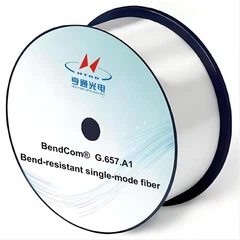
G.657, an ITU-T-defined bend-insensitive single-mode fiber, minimizes bending losses through advanced core and cladding designs. Key innovations include:
Refractive Index Profile Optimization
Trench-Assisted Design: A low-refractive-index ring around the core acts as a "light trap" to reduce signal leakage.
Mode Field Diameter (MFD) Matching: Adjusted core profiles enhance light confinement under bending conditions.
3. Top 4 Applications of G.657 Fiber
FTTH (Fiber-to-the-Home)
Survives sharp bends and tight bundling in residential wiring.
Case Study: NTT Japan uses G.657.A2 for 90° wall corner installations.
5G Indoor Networks
Enables dense cabling in elevators, ducts, and confined spaces.
High-Density Data Centers
Reduces cabling space in racks with LC/MPO connectors.
Industrial & Vehicular Communications
Resists vibration and crushing in factories, trains, or robotics.
Conclusion
G.657 fiber redefines flexibility in optical communication, solving critical challenges in complex wiring environments. From residential broadband to Industry 4.0, its low bending loss properties are driving networks toward unprecedented reliability and adaptability. By selecting the right G.657 subtype and adhering to installation best practices, you can future-proof your optical infrastructure against the twists and turns of real-world deployments.