

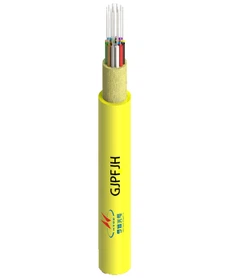


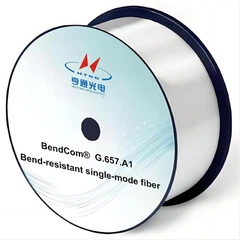
The principle of optical fiber transmission is based on the phenomenon of total internal reflection, which enables the transmission of information through optical fibers (light-conducting fibers). Typically, optical fibers are made from a core with a high refractive index and a cladding with a lower refractive index. When light enters the fiber core, total internal reflection occurs at the interface between the core and the cladding, causing the light to propagate in a zigzag pattern and enabling the transmission of information. Below is a detailed explanation of the principle of optical fiber transmission:
Total Internal Reflection of Light
When light travels from a denser medium (a medium with a higher refractive index) to a less dense medium (a medium with a lower refractive index), if the angle of incidence exceeds the critical angle, the light will be entirely reflected back into the denser medium, rather than passing into the less dense medium. This phenomenon is known as total internal reflection.
The critical angle is the angle of incidence corresponding to a refraction angle of 90 degrees. Total internal reflection only occurs when light travels from a denser medium into a less dense medium and the angle of incidence is greater than the critical angle.
Structure and Materials of Optical Fiber
Optical fibers consist of a core and a cladding, with the core having a higher refractive index than the cladding, which has a lower refractive index. Light undergoes total internal reflection at the interface between the core and the cladding, allowing it to propagate along the fiber.
Working Principle of Optical Fiber Transmission
Transmitter end: The signal to be transmitted (analog signal or digitized pulse electrical signal) is modulated onto a light source, converting it from an electrical signal to an optical signal.
Transmission process: The modulated light wave propagates along the fiber core. When the light encounters the interface between the core and the cladding, total internal reflection occurs because the angle of incidence is greater than the critical angle, allowing the light to continue traveling within the fiber.
Receiver end: When the light reaches the other end, it is demodulated and converted back into an electrical signal using a demodulator, completing the information transmission process.
Characteristics of Optical Fiber Transmission
High-speed transmission: A single optical fiber can achieve data transmission rates of several Gbps.
Long-distance transmission: Optical fibers can transmit over tens of kilometers without the use of repeaters.
Low loss: Optical fiber transmission exhibits low loss. For light at a wavelength of 1.31 µm, the transmission loss is below 0.35 dB per kilometer, and for light at 1.55 µm, the loss is even lower, at less than 0.2 dB per kilometer.
Recent Developments in Optical Fiber Technology
In recent years, the rapid development of optical fiber communication technology has led to significant advancements in fiber materials, structural designs, and signal processing techniques. The introduction of low-loss materials, such as pure silica and doped glasses, and refined fiber geometries, including smaller core diameters and optimized cladding designs, have further minimized transmission losses and improved efficiency.
Research into nonlinear optical effects has facilitated the development of multimode fibers and space-division multiplexing (SDM) technologies. Multimode fibers allow multiple light paths, or modes, to travel down the fiber, while SDM enables the use of several spatial channels within a single fiber. These advancements have substantially increased the transmission capacity of individual optical fibers, allowing them to carry terabits of data per second.
Current studies are also exploring novel fibers such as hollow-core fibers, which guide light through an air-filled core rather than a solid one. This design reduces scattering and absorption losses, enabling lower attenuation and greater bandwidth potential. Hollow-core fibers are showing promise for ultra-low latency and high-speed data transmission in applications such as high-frequency trading and real-time medical imaging.
Furthermore, cutting-edge optical amplification technologies, such as erbium-doped fiber amplifiers (EDFAs), Raman amplifiers, and parametric amplifiers, are pushing the boundaries of ultra-long-distance and ultra-high-speed transmissions. EDFAs, for instance, allow signals to be amplified without electrical conversion, maintaining high data integrity over vast distances. These technologies enable optical communication systems to cover thousands of kilometers without significant signal degradation, making them critical for global telecommunications networks and subsea cable systems.
Emerging Applications and Future Prospects
These innovations are extending the applicability of optical fiber technologies into advanced fields such as:
Quantum communication, where optical fibers are being used to transmit quantum bits (qubits) for highly secure communication systems.
5G networks, where the high bandwidth and low latency of fiber optics are critical for supporting the massive data requirements of next-generation wireless systems.
Data center interconnects, which rely on fiber optics to transfer vast amounts of data quickly and efficiently between different locations.
In addition to these applications, there is ongoing research into the integration of optical fibers with photonics and optical computing, which could revolutionize information processing by enabling faster, more energy-efficient computational systems.
Conclusion
Optical fiber transmission leverages the principle of total internal reflection, utilizing the structure of the fiber core and cladding to achieve long-distance, high-speed, and low-loss information transmission. Recent developments in fiber materials, design, and amplification technologies have further enhanced the performance and capabilities of optical fibers, making them indispensable in modern communication infrastructures. As research continues, optical fibers are expected to play a key role in the future of telecommunications, quantum communication, and beyond, driving further innovation in information technology and networked systems.