



Hey there! As a supplier of single mode fiber, I often get asked about the commonly used wavelengths in single mode fiber. So, I thought I'd write this blog to share some insights on this topic.

First off, let's understand what single mode fiber is. Single mode fiber is a type of optical fiber that allows only one mode of light to propagate through it. This results in less dispersion and allows for longer - distance and higher - bandwidth communication compared to multimode fiber.

Now, onto the wavelengths. There are several wavelengths that are commonly used in single mode fiber, and each has its own unique characteristics and applications.
1310 nm Wavelength
The 1310 nm wavelength is one of the most popular choices for single mode fiber. At this wavelength, the single mode fiber has a relatively low dispersion. Dispersion is the phenomenon where different wavelengths of light travel at different speeds through the fiber, causing the light pulses to spread out over time. With low dispersion at 1310 nm, the light signals can maintain their shape over long distances, which is great for high - speed data transmission.
This wavelength is widely used in telecommunications networks, especially for short - to - medium - distance links. For example, in local area networks (LANs) and some metropolitan area networks (MANs), 1310 nm single mode fiber is often the go - to option. It can support data rates of up to 10 Gbps and even higher in some cases, making it suitable for a wide range of applications from basic internet access to high - definition video streaming.
1550 nm Wavelength
The 1550 nm wavelength is another crucial one in the world of single mode fiber. One of the key advantages of the 1550 nm wavelength is its low attenuation. Attenuation refers to the loss of signal strength as the light travels through the fiber. Since the attenuation is low at 1550 nm, the light signals can travel much longer distances without significant loss.
This makes it ideal for long - haul telecommunications, such as trans - oceanic cables and long - distance backbone networks. In these applications, the ability to transmit signals over thousands of kilometers without frequent signal regeneration is essential. Additionally, the 1550 nm wavelength is also used in some high - capacity fiber - to - the - home (FTTH) deployments, where it can carry multiple channels of data, voice, and video services to individual homes.
Other Wavelengths
Apart from 1310 nm and 1550 nm, there are other wavelengths that are also used in specific applications. For example, the 1625 nm wavelength is used in some fiber optic sensing applications. Fiber optic sensors can be used to measure various physical parameters such as temperature, strain, and pressure. The 1625 nm wavelength is suitable for these applications because it can interact with the physical properties of the fiber in a way that allows for accurate measurements.
Now, let's talk about some of the specific types of single mode fiber that are designed to work well with these wavelengths.
G.652.D
The G.652.D is a widely used single mode fiber standard. It is optimized for operation at both 1310 nm and 1550 nm wavelengths. This fiber has low attenuation and dispersion characteristics at these wavelengths, making it suitable for a wide range of applications from short - distance LANs to long - distance telecommunications networks. It has been around for a long time and is well - established in the market, which means there is a large ecosystem of compatible equipment available.
LL - G.652.D
The LL - G.652.D is an enhanced version of the G.652.D fiber. The “LL” stands for “Low Loss”. This fiber has even lower attenuation than the standard G.652.D, especially at the 1550 nm wavelength. This makes it an excellent choice for long - haul and high - capacity networks where minimizing signal loss is crucial. It can support higher data rates and longer transmission distances, reducing the need for signal repeaters and amplifiers.
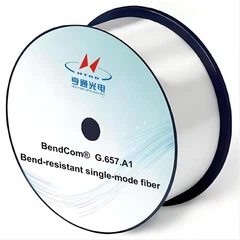
G.657.A1
The G.657.A1 fiber is designed for bend - insensitive applications. It can tolerate tight bends without significant signal loss, which is very useful in indoor and in - building installations where the fiber may need to be routed around corners or through small spaces. This fiber also works well at both 1310 nm and 1550 nm wavelengths, making it a versatile option for various applications.
In conclusion, the choice of wavelength in single mode fiber depends on the specific application requirements. Whether it's short - distance high - speed data transmission or long - haul telecommunications, there is a suitable wavelength and fiber type available.
If you're in the market for single mode fiber, whether it's for a new project or an upgrade to an existing network, I'd love to talk to you. We have a wide range of single mode fiber products, including those optimized for different wavelengths, to meet your needs. Don't hesitate to reach out for a discussion about your specific requirements and how we can help you find the best solution.
References

- ITU - T Recommendations on Optical Fibers
- Technical documents from major fiber optic manufacturers