



Yo! I'm stoked to chat about how single mode fiber is a total game - changer for the Internet of Things (IoT). As a single mode fiber supplier, I've seen firsthand how this tech is shaping the IoT landscape.
Let's start with the basics. Single mode fiber is a type of optical fiber that allows only one mode of light to propagate through it. Unlike multimode fiber, which has a larger core and can carry multiple light modes, single mode fiber has a much smaller core, usually around 9 microns. This small core size results in less signal dispersion, allowing the fiber to transmit data over much longer distances with higher bandwidth.
Now, when it comes to IoT, data is king. IoT devices are everywhere - from smart home appliances and wearables to industrial sensors and autonomous vehicles. These devices continuously generate, collect, and transmit vast amounts of data. And single mode fiber is the perfect medium to handle this data flood.
One of the key aspects of IoT is connectivity. For IoT to function effectively, all the devices need to be connected seamlessly. Single mode fiber offers extremely high - speed data transmission, which is crucial for real - time communication between IoT devices. Whether it's a smart city project where traffic sensors need to send data to a central control system instantly or a healthcare IoT application where patient monitors need to transfer vital signs to doctors in real - time, single mode fiber can handle the job.
Take, for example, a large - scale industrial IoT (IIoT) setup in a manufacturing plant. There are hundreds, if not thousands, of sensors installed on machinery to monitor performance, temperature, vibration, and other parameters. These sensors generate a constant stream of data that needs to be analyzed quickly to detect any potential issues. Single mode fiber can transmit this data at speeds of up to 100 Gbps or even higher, ensuring that the data reaches the analytics platform without any significant delay.
Another important factor is reliability. IoT systems often operate in harsh environments. For instance, IoT sensors in oil and gas pipelines are exposed to extreme temperatures, humidity, and chemical substances. Single mode fiber is highly resistant to environmental factors. It doesn't suffer from electromagnetic interference, which is a common problem in copper - based cables. This means that the data transmission remains stable and reliable, even in the most challenging conditions.
When it comes to the types of single mode fiber we offer, we have some great options. One of them is G.652.D. It's a widely used standard single mode fiber. It has low attenuation, which means the signal can travel long distances without significant loss. This makes it ideal for long - haul IoT networks, such as those used in large - scale agricultural IoT projects where sensors are spread across vast fields.
We also have SL - G.652.D. This fiber is an enhanced version of G.652.D. It offers better bend performance, which is useful in IoT deployments where the fiber may need to be routed around tight corners, like in smart building installations.
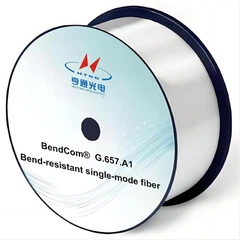
And then there's G.657.A1 - PLUS. This fiber is designed for high - density IoT networks. It has excellent resistance to micro - bending, which can occur when the fiber is installed in cramped spaces. In a data center IoT setup, where there are a large number of devices packed closely together, G.657.A1 - PLUS can ensure reliable data transmission.
Scalability is another area where single mode fiber shines in the context of IoT. As the number of IoT devices continues to grow exponentially, the network needs to be able to handle the increased data traffic. Single mode fiber has the capacity to scale up easily. You can upgrade the network by simply increasing the transmission speed or adding more fibers to the existing infrastructure.
Cost - effectiveness is also a big deal. Although the initial installation cost of single mode fiber may be higher compared to some other types of cables, in the long run, it's a more cost - effective solution. Since it has a longer lifespan and requires less maintenance, the total cost of ownership over time is lower. And with the high - speed data transmission it offers, it can significantly improve the efficiency of IoT systems, leading to cost savings in other areas, such as reduced downtime in industrial IoT applications.
In addition to the technical advantages, single mode fiber also plays a role in energy efficiency. IoT devices are often battery - powered, especially in remote or hard - to - reach locations. By using single mode fiber for data transmission, the devices can consume less power as they don't need to send data over long distances wirelessly. This helps in extending the battery life of IoT devices, which is a major concern in many IoT deployments.


To sum it up, single mode fiber is the backbone of the IoT revolution. Its high - speed data transmission, reliability, scalability, cost - effectiveness, and energy - saving features make it an essential component for the successful implementation of IoT systems.
If you're involved in an IoT project, whether it's a small - scale smart home setup or a large - scale industrial IoT initiative, we're here to help. We can provide you with the right single mode fiber solution tailored to your specific needs. So, if you're interested in learning more or want to start a procurement discussion, don't hesitate to reach out. We're ready to work with you to take your IoT project to the next level.
References
- "Optical Fiber Communication Systems" by Govind P. Agrawal
- "Internet of Things: A Vision, Architectural Elements, and Future Directions" by Jayavardhana Gubbi et al.
- Industry whitepapers on single mode fiber and IoT applications.