



The outer jacket is the part of an optical cable that takes the first hit from sunlight, water, soil pressure, rodents, fire and oil - and it has to keep doing that for 20 to 30 years. Yet on most procurement sheets it is reduced to a single word: PE, LSZH, or PVC. That shorthand hides the choices that actually decide whether a cable lasts a full design life in a duct or fails in five years on a coastal pole line.
This guide explains what each common sheath material does well, where it fails, and how to match the jacket to the real installation environment so the cable delivers the service life its datasheet promises.
What the Outer Sheath Actually Does
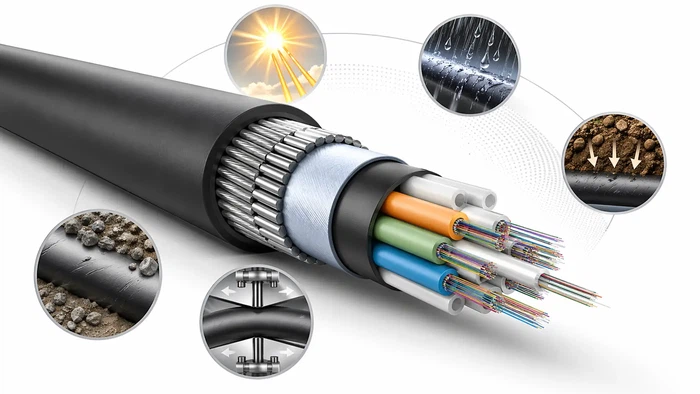
The jacket is not a cosmetic layer. It carries several jobs at once: mechanical protection against crushing and abrasion, a moisture barrier (the leading long-term cause of attenuation drift), UV and thermal aging resistance, chemical resistance, and controlled fire behavior. No single polymer is best at all of these, which is why jacket selection is always a trade-off.
It is also worth remembering that the jacket is only one layer of the cable's defense system. For demanding environments, water-blocking elements, strength members, armoring and inner sheaths share the load. The jacket sets the outer envelope; the construction inside finishes the job. You can see this clearly in how fiber optic cable materials are layered together.
The Main Sheath Materials in Use Today
PE and HDPE (Polyethylene)
Polyethylene is the workhorse jacket for outdoor cables. Standard medium-density PE and high-density PE (HDPE) offer low water absorption, good UV stability when properly carbon-black loaded (typically ≥ 2.3% per ITU-T and IEC outdoor cable specifications), and acceptable abrasion resistance at a reasonable cost. HDPE in particular dominates as the outer jacket for duct fiber optic cable and direct burial cable, where its hardness, low pull friction and resistance to soil chemistry are real advantages.
The often-repeated claim that "PE is unsuitable for underground use" is misleading. HDPE is in fact the standard outer jacket for buried cables - but it works because it sits on top of armoring, water-blocking elements, and sometimes rodent-resistant layers. The jacket is one element of the system, not the whole system.
Where PE genuinely struggles: fire performance (it burns readily), prolonged exposure to oils and aromatic hydrocarbons, and continuous service above roughly 75–80 °C.
LSZH (Low Smoke Zero Halogen)
LSZH compounds - typically polyolefins filled with aluminum trihydrate or magnesium hydroxide - are designed for spaces where people may need to evacuate during a fire. They emit low smoke densities (tested to IEC 61034) and essentially no halogen acid gases (IEC 60754-2), and they resist flame propagation under bundled-cable tests such as IEC 60332-3.
LSZH is the standard for indoor backbones, equipment rooms, tunnels, transit systems and many data centers. However, the claim that LSZH is "mandatory in modern building codes" overstates the picture. North American plenum spaces require OFNP-rated cables and risers require OFNR - neither identical to LSZH. In Europe, the Construction Products Regulation (CPR) classifies cables on a Euroclass scale (B2ca, Cca, Dca and so on), and the required class depends on the building and the member state. Always verify the local code rather than assume "LSZH equals compliant."
One more nuance: LSZH does not equal "fire-resistant." For circuits that must keep operating during a fire, you need a fire-resistant fiber optic cable with a dedicated fire-barrier construction, not just an LSZH jacket.
PVC (Polyvinyl Chloride)
PVC is the cheap, easy-to-process indoor jacket. With the right additive package it can be flame-retardant and is common on patch cords, simple riser cables and general-purpose indoor wiring. Its trade-offs are well documented: when it burns it produces dense black smoke and hydrogen chloride gas, both of which create evacuation hazards and corrode electronics. That is why the industry moved toward LSZH and plenum-rated alternatives for safety-critical indoor spaces. PVC also stiffens at low temperatures and softens at moderately high ones, which is why it rarely appears on outdoor or industrial cables.
Specialty Jackets: PUR, TPU and Nylon
For industrial environments - robotics, oil and gas, mining - standard polyolefins are not enough. Polyurethane (PUR) and thermoplastic polyurethane (TPU) offer superior abrasion resistance, oil and chemical resistance, and flexibility for cables that move repeatedly. Polyamide (nylon) is sometimes added as an overjacket on HDPE in termite and rodent territory because it is extremely hard to bite through.
PE vs LSZH vs PVC at a Glance
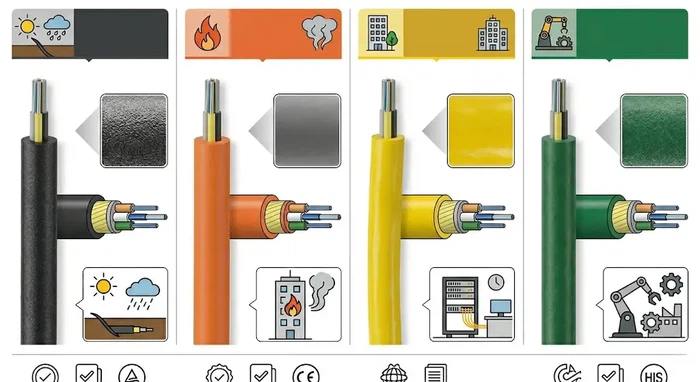
Most procurement debates come down to these three. The key differences:
| Property | PE / HDPE | LSZH | PVC |
|---|---|---|---|
| Primary use | Outdoor (aerial, duct, buried) | Indoor, data center, public spaces | Low-cost indoor, patch cords |
| UV / weathering | Excellent (with carbon black) | Poor - not for outdoor use | Poor - degrades quickly outdoors |
| Water absorption | Very low | Higher than PE | Moderate |
| Fire behavior | Burns readily, drips | Low smoke, no halogens, flame-retardant | Flame-retardant but heavy smoke and HCl gas |
| Temperature range | Wide (typ. −40 to +70 °C) | Moderate | Narrow |
| Relative cost | Low | Higher | Lowest |
How Sheath Materials Affect Service Life
"Service life" is not a single number. A well-specified outdoor cable is typically designed for 25 to 30 years of service, but that figure assumes the jacket is operating within its intended environment. Push it outside and the curve drops sharply.
The jacket properties that drive how long a cable actually lasts:
- UV and weathering resistance - decisive for aerial cables and any installation in high-irradiance regions.
- Operating temperature range - repeated cycling near the limits accelerates aging.
- Water absorption and moisture barrier - moisture inside a cable produces hydrogen, which raises attenuation over time.
- Tensile and crush resistance - relevant for blown installations, long pulls, and traffic-loaded burial.
- Chemical and oil resistance - decisive in industrial and petrochemical sites where standard PE will harden and crack within a few years.
- Fire behavior - measured by IEC 60332 (flame spread), IEC 61034 (smoke density), and IEC 60754 (halogen content). The IEC 60332 series is the most commonly cited reference in tender documents.
Matching the Jacket to the Installation Environment
A practical way to specify a jacket is to start from the environment, not the material:
- Aerial spans (ADSS, figure-8): UV-stabilized HDPE is standard. Near high-voltage lines, anti-tracking HDPE is required to resist surface arcing.
- Duct and pulled installations: HDPE for low pull friction. Long blown runs require especially low-friction outer surfaces.
- Direct buried: HDPE outer jacket plus steel tape or steel wire armoring, water-blocking elements, and rodent protection where ground squirrels, gophers or termites are present. Anti-rodent constructions typically use steel tape armor, additional sheath layers, or nylon overjackets.
- Indoor risers and general indoor: LSZH in most international markets, OFNR in North America.
- Plenum spaces (return-air spaces in North America): OFNP-rated jackets, defined under NFPA 70 (NEC). Not interchangeable with LSZH.
- Data centers and tunnels: LSZH, often combined with fire-resistant designs for safety-critical paths.
- Industrial / oil and flexing environments: PUR or TPU jackets for chemical, oil, abrasion and flex life.
- Coastal and high-salinity: UV-stable HDPE plus careful attention to armor corrosion. Non-metallic constructions are often preferred to eliminate galvanic issues.

What to Verify When You Procure
Specifying the right material is only half the work - you also need to confirm that what arrives matches the spec. Worth requesting from the supplier:
- Carbon-black content for outdoor PE/HDPE jackets (≥ 2.3% is the common threshold).
- Flame-test reports (IEC 60332-1 single cable or IEC 60332-3 bundled, depending on the application).
- Smoke density (IEC 61034) and halogen content (IEC 60754) certificates for LSZH.
- For plenum or riser cables in North America, the UL listing reference (OFNP, OFNR or OFN).
- Operating temperature range and minimum installation temperature.
- Jacket thickness against the relevant standard - this single parameter strongly affects long-term durability.
FAQ
What is the difference between PE and LSZH for fiber optic cables?
PE is an outdoor jacket optimized for UV resistance, low moisture absorption and cost. LSZH is an indoor jacket optimized for fire safety - low smoke and no halogen gases when burned. They are not substitutes; PE should not be installed indoors in safety-critical spaces, and LSZH should not be used outdoors.
Is LSZH the same as fire-resistant?
No. LSZH describes how the jacket behaves when it burns (low smoke, no halogens). Fire-resistant cables are engineered to keep transmitting during a fire, which requires additional fire-barrier construction. The two requirements often appear together but are not interchangeable.
How long should an optical cable jacket last?
Well-specified outdoor cables are typically designed for 25 to 30 years of service, and indoor cables for the life of the building. Actual service life depends on whether the jacket is operating within its intended UV, temperature and chemical envelope. Cables installed outside their design envelope can fail in well under a decade.
Why is HDPE used for both aerial and direct-buried cables when their stresses are so different?
Because HDPE handles UV, moisture, abrasion and a wide temperature range well, and the rest of the cable structure - strength members, armoring, water blocking - handles what the jacket alone cannot. The same material plays different roles depending on what sits underneath it.
Summary
PE and HDPE dominate outdoor use because they handle UV, moisture and cost well. LSZH and OFNR/OFNP cover indoor fire-safety requirements, with the exact rating dictated by local code rather than a generic "LSZH" label. PVC remains a budget indoor option with real fire-behavior trade-offs. Specialty jackets like PUR and TPU exist precisely because no general-purpose polymer covers industrial extremes. Specify the jacket against the actual environment and code, treat it as one layer in a system, and the cable will deliver the service life its datasheet promises.