





Fiber optic cables transmit data as light pulses through glass cores, while connectors provide the detachable precision interfaces that join optical links. Together, they determine the insertion loss, return loss, bandwidth, and transmission distance of every fiber network - from FTTH access lines to 400G/800G data center backbones. This article covers how optical fiber transmission works, the major cable and connector types, the performance parameters that matter most, and practical engineering considerations for installation and maintenance.
How Optical Fiber Transmission Works
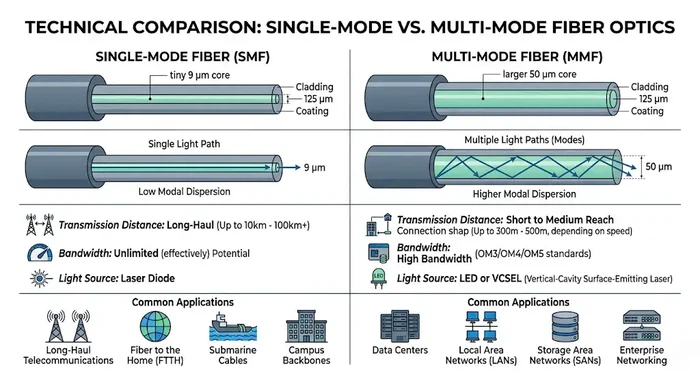
Optical fiber carries data through total internal reflection of light signals within a silica-based core. A standard fiber strand has three layers: the core, which carries the light; the cladding, which has a lower refractive index to confine light inside the core; and a polymer coating that protects the glass from mechanical stress and environmental damage.
Unlike copper cables, optical fibers are immune to electromagnetic interference (EMI) and radio frequency interference (RFI), exhibit extremely low signal attenuation, and support far greater bandwidth. A single-mode fiber operating at 1550 nm typically loses only about 0.2 dB/km - enabling transmission over tens or even hundreds of kilometers without regeneration. These characteristics make optical fiber the only viable medium for long-distance, high-speed, large-capacity communication. For more on fiber optic cable materials and construction, see our detailed guide.

Fiber Optic Cable Types: Single-Mode and Multi-Mode
Fiber optic cables fall into two categories based on how light propagates through the core: Single-Mode Fiber (SMF) and Multi-Mode Fiber (MMF). Each serves distinct distance and bandwidth requirements.
Single-Mode Fiber (SMF)
Single-mode fiber has a core diameter of only 9 µm, supporting just one transmission mode of light. Its attenuation coefficient is low - typically 0.18–0.25 dB/km at 1550 nm - enabling long-distance transmission from 10 km to well over 100 km. The most common SMF types defined by ITU-T standards include:
- G.652D - The standard single-mode fiber. It eliminates the water peak at 1383 nm, supports CWDM across the 1310–1625 nm window, and achieves PMD below 0.2 ps/√km. G.652D is the default for backbone networks, metro networks, and long-haul transmission.
- G.655 - Non-zero dispersion-shifted fiber, originally developed for DWDM long-haul systems. Now largely superseded by G.652D in new deployments.
- G.657 - Bend-insensitive fiber for FTTH and indoor environments. G.657.A1 allows a minimum bend radius of 10 mm (versus 30 mm for G.652D), while G.657.A2 permits bends down to 7.5 mm. G.657.A subcategories are backward compatible with G.652D, simplifying splicing during upgrades.
SMF is widely deployed in backbone networks, metro networks, long-haul transmission, and outdoor FTTH drop cable installations. Explore our single-mode fiber product range.
Multi-Mode Fiber (MMF)
Multi-mode fiber has a larger core diameter of 50 µm (or 62.5 µm in legacy OM1), supporting multiple light modes simultaneously. Although transmission distance is limited - typically under 550 m - MMF pairs well with low-cost VCSEL (vertical-cavity surface-emitting laser) transceivers, making it cost-effective for short-reach, high-speed links. Modern MMF grades classified under ISO/IEC 11801 include:
- OM3 - Laser-optimized fiber with effective modal bandwidth (EMB) of 2000 MHz·km at 850 nm. Supports 10GBASE-SR up to 300 m and 40G/100GBASE-SR4 up to 100 m.
- OM4 - Enhanced bandwidth of 4700 MHz·km at 850 nm. Extends 10GBASE-SR to 400 m, 40GBASE-SR4 to 150 m, and 100GBASE-SR4 to 100 m. The most widely deployed MMF grade in new data center builds.
- OM5 - Wideband multi-mode fiber (WBMMF) with an additional specified wavelength at 953 nm for short-wavelength division multiplexing (SWDM), supporting 40G/100G/400G over fewer fiber strands.
MMF is the first choice for data center internal cabling, campus networks, and equipment room interconnections. Browse our multimode fiber products for OM3, OM4, and OM5 options.
Cable Structure for Different Environments
Beyond fiber type, cable construction is critical. Tight-buffered cables are used indoors for flexibility and easy termination. Outdoor deployments use loose-tube, gel-filled, or dry water-blocked cables with armor for direct burial, duct, or aerial installations - designed to resist moisture ingress, tensile loads, and crush forces.
Fiber Optic Connector Types and End-Face Polishing
Fiber optic connectors are high-precision mechanical components that create detachable connections between optical fibers. Their core performance indicators - insertion loss (IL), return loss (RL), durability, and environmental stability - directly affect link quality. Poor alignment, end-face contamination, or structural defects will degrade or interrupt optical transmission.
Common Connector Types
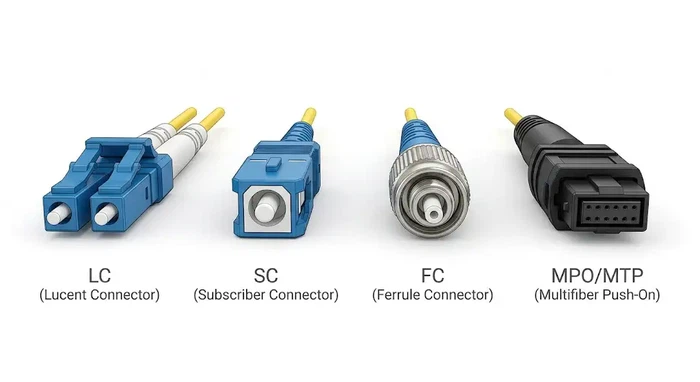
- LC Connector - Small form-factor with a 1.25 mm ceramic ferrule and push-pull latching. Enables twice the port density of SC. Dominant in high-density data centers and the standard interface for 10G/25G/40G/100G transceivers.
- SC Connector - 2.5 mm ferrule with snap-in push-pull coupling. Robust, easy to terminate, and cost-effective. Widely used in telecom access, FTTH ONT connections, and PON equipment.
- FC Connector - Threaded screw-on coupling providing excellent mechanical stability and vibration resistance. Common in test instruments, optical transmission systems, and industrial environments.
- MPO/MTP Connector - Multi-fiber array connector supporting 8 to 72 fibers in a single ferrule. Essential for parallel optical transmission in 400G/800G data center interconnects. See our MPO/MTP products.
End-Face Polishing: PC, UPC, and APC
End-face polishing directly determines return loss. Three types are in standard use, governed by IEC 61755 (end-face geometry) and IEC 61753 (performance grades):
- PC (Physical Contact) - Slight convex curve for direct contact. Return loss ≥ 40 dB. Largely superseded by UPC in single-mode applications.
- UPC (Ultra Physical Contact) - Finer polish achieving return loss ≥ 50 dB. The default for data center, LAN, and digital telecom links. Blue color coding.
- APC (Angled Physical Contact) - 8° angled end-face redirecting reflections into the cladding. Return loss ≥ 60 dB. Required in CATV, PON/FTTH, DWDM, and reflection-sensitive systems. Green color coding.
Important: APC and UPC connectors must never be mated together. The geometry mismatch causes severe insertion loss and can damage both ferrules.
Key Performance Parameters
Two parameters define the optical quality of every connector and cable assembly:
Insertion Loss (IL) is the optical power lost when a signal passes through a connector, splice, or component. Typical IL should be below 0.3 dB for factory assemblies and below 0.5 dB for field terminations. Lower IL preserves link budget and supports longer reach.
Return Loss (RL) measures how much light reflects back toward the source. Higher absolute RL values mean less reflection. Industry standards specify minimum RL of 40 dB for PC, 50 dB for UPC, and 60 dB for APC connectors. Excessive back-reflection destabilizes lasers, increases bit error rates, and causes distortion in analog systems.
Other critical parameters include attenuation coefficient (dB/km), bandwidth (MHz·km for MMF), chromatic dispersion, and polarization mode dispersion (PMD). All should be verified per fiber optic cable testing standards before acceptance.
Engineering Applications: Installation and Maintenance
Even the best fiber and connectors will underperform without proper installation practices.
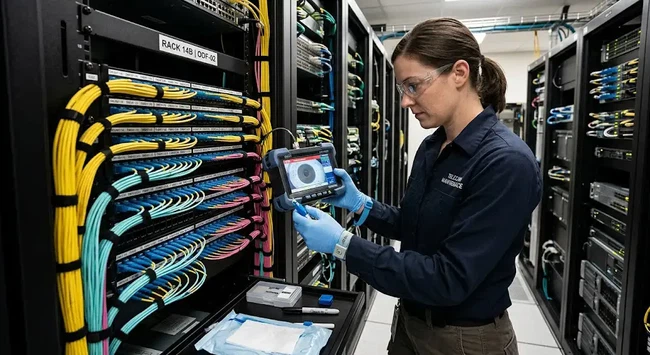
End-face cleaning is the single most critical task. Dust particles as small as 1 µm can block a meaningful portion of a single-mode fiber's 9 µm core. Every connector must be inspected and cleaned before mating using lint-free swabs, IPA cleaning pens, or cassette-style cleaners, then verified with a fiber microscope at 200× or higher magnification.
Bending radius must be respected. Exceeding the minimum bend radius introduces microbend loss. For standard single-mode cable, this limit is typically 30 mm; for G.657.A1 bend-insensitive fiber, it drops to 10 mm.
Tensile load limits must not be exceeded. Pulling cables beyond their rated maximum force during installation can stretch or crack fibers inside the cable. Always use proper pulling equipment and follow manufacturer specifications.
For large-scale projects such as data center connectivity deployments, pre-connectorized cable assemblies with factory-tested performance reduce installation time and minimize contamination risk.
Frequently Asked Questions
What is the difference between single-mode and multi-mode fiber?
Single-mode fiber has a 9 µm core carrying one light mode, supporting transmission from 10 km to over 100 km. Multi-mode fiber has a 50 µm core carrying multiple modes, limiting range to a few hundred meters but using cheaper VCSEL transceivers for cost-effective short-reach links.
What do PC, UPC, and APC return loss values mean?
PC achieves ≥ 40 dB, UPC ≥ 50 dB, and APC ≥ 60 dB. Higher values mean less back-reflection. APC's 8° angled end-face is the best choice for reflection-sensitive systems like PON, CATV, and DWDM.
Can APC and UPC connectors be connected together?
No. The angled and flat end-faces create an air gap when mated, causing high insertion loss and physical damage. Always match APC to APC and UPC to UPC.
What is the maximum reach of OM3 and OM4 fiber?
For 10GBASE-SR, OM3 supports up to 300 m and OM4 up to 400 m. For 100GBASE-SR4 with MPO connectors, OM3 reaches 70 m and OM4 reaches 100 m, as defined by IEEE 802.3 Ethernet standards.
Why is end-face cleaning so important?
Contamination is the leading cause of fiber connector failures. A single dust particle on the core can significantly increase insertion loss. Every connector should be cleaned and inspected before each mating.