





When a fiber optic route passes through areas where rodents are active, runs underground through wet soil, spans exposed poles, or crosses industrial sites, a standard cable jacket alone may not hold up. That is where armoured fiber optic cable - also written as armored fiber optic cable in North American usage - plays a critical role.
An armoured fiber optic cable includes one or more additional protective layers around the optical core. Depending on the design, that protection might come from corrugated steel tape, stainless steel wire, or non-metallic materials such as fiberglass-reinforced plastic (FRP) or glass-reinforced plastic (GRP). Some designs also incorporate water-blocking elements, UV-resistant outer jackets, and aramid yarn strength members. Each of these features serves a different purpose, and no single "armored" label tells you everything about how the cable will perform in the field.

What Is Armoured Fiber Optic Cable?
An armoured fiber optic cable is a fiber cable built with an additional protective structure - typically a metallic or non-metallic armor layer - so the fibers inside are better shielded from physical damage, moisture ingress, and environmental hazards. The IEC 60794 series establishes the general specifications for optical fiber cables, including requirements for mechanical performance such as crush resistance, impact strength, tensile rating, and environmental durability. These specifications apply to armoured designs as well as standard cables.
One point that often causes confusion: "armoured cable" is not a single product category. A cable designed for aerial installation on utility poles, one built for direct burial in soil, and one rated for indoor riser environments may all carry an "armored" designation - but they solve different problems with different constructions. Treating them as interchangeable is one of the most common specification errors in cable procurement.
Why Standard Fiber Cables Fail in Harsh Environments
Not every fiber route needs armoured cable. In a well-protected indoor pathway or a sealed conduit system, a standard fiber optic cable may be perfectly adequate. But when the cable faces one or more of the following physical risks, armor becomes a serious consideration:
- Rodent and animal damage. Gophers, squirrels, and rats can gnaw through standard polyethylene jackets relatively quickly. According to Corning's application engineering note on rodent resistance (AEN013), years of field testing have confirmed that corrugated carbon steel tape longitudinally wrapped around the cable core is the most widely accepted and effective method of rodent protection for outside plant cables.
- Moisture and water ingress. Underground and duct routes expose cables to standing water, soil moisture, and flooding events. Without proper water-blocking protection, water can migrate along the cable core and degrade fiber performance over time.
- UV exposure. Cables installed on exterior walls, rooftops, or aerial spans face long-term ultraviolet degradation if the outer jacket material is not formulated for UV resistance.
- Crush and impact loads. Cables in direct-burial applications, industrial environments, or high-traffic surface runs face mechanical stresses that exceed what a single-jacket cable can handle.
- Tensile stress on aerial spans. Suspended cable runs need adequate tensile strength and sag performance to handle wind, ice, and their own weight over the span distance.
A common mistake in cable selection is focusing only on rodent protection. In practice, the best armoured cable choice for a given route usually needs to balance multiple protection requirements - physical armor, moisture control, UV resistance, and mechanical loading - rather than relying on a single feature.
Metallic vs Non-Metallic Armor: Which Is Right for Your Route?
The choice between metallic and non-metallic armoring depends on the specific threats, environmental conditions, and installation requirements of the route.
Metallic Armor
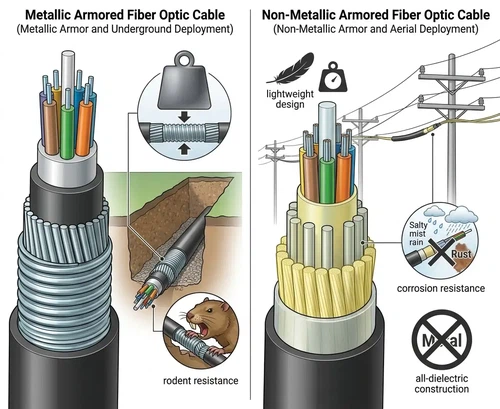
Metallic armor - typically corrugated steel tape (CST), stainless steel tape, or steel wire - provides the strongest physical barrier against rodent attack and high crush loads. Corning's rodent resistance research documents that steel tape armor has proven its effectiveness over many years of field service and remains the most widely accepted approach for protecting outside plant cables against burrowing and gnawing animals. For routes where rodent exposure is the primary concern, metallic armor remains the default recommendation for many network planners.
Metallic armor also adds meaningful crush and impact resistance, which matters in direct-burial and duct applications where the cable may face soil pressure or accidental contact with digging equipment. On the other hand, metallic armor adds weight, requires grounding in some installations, and is susceptible to corrosion in wet or chemically active soil.
Non-Metallic Armor
Non-metallic armoring - using FRP rods, GRP layers, or glass yarn wraps - provides a lightweight, corrosion-resistant, all-dielectric alternative. AFL positions its non-metallic armoured fibre optic cables with GRP and FRP armouring as suitable for underground and harsh environments where corrosion resistance and light weight are priorities. Because these designs contain no metallic components, they eliminate grounding requirements and are immune to electromagnetic interference - a real advantage when cables must run alongside power lines or through areas with high lightning risk.
Non-metallic armored cables also work well where the primary risk is moderate physical abrasion or termite damage rather than aggressive burrowing rodents. For anti-rodent protection, glass yarn layers beneath the outer jacket create a barrier that deters chewing, though the protection level differs from that provided by a full corrugated steel tape wrap.
Metallic vs Non-Metallic Armor
| Feature | Metallic Armor (Steel Tape / Wire) | Non-Metallic Armor (FRP / GRP / Glass Yarn) |
|---|---|---|
| Rodent resistance | Strongest barrier; field-proven over decades | Deterrent-level; effective against moderate chewing |
| Crush and impact protection | High | Moderate to high depending on design |
| Weight | Heavier | Significantly lighter (FRP is roughly 1/4 the weight of steel) |
| Corrosion resistance | Vulnerable in wet or acidic soil | Excellent; no corrosion risk |
| Electrical conductivity | Conductive; may require grounding | All-dielectric; no grounding needed |
| EMI / lightning immunity | Not immune | Immune; suitable near power infrastructure |
| Typical applications | Direct burial, duct, high rodent exposure | Aerial, underground, near power lines, corrosive environments |
The right choice is route-specific. If your deployment faces heavy rodent pressure from burrowing gophers in direct-burial soil, metallic armor is likely the stronger option. If you need a lightweight, corrosion-resistant cable for an aerial span or an underground route near power infrastructure, non-metallic armoring may be the better fit.
Water-Blocking, UV Protection, and Outer Jackets
Armor handles physical threats, but it does not automatically protect against moisture or sunlight. These are separate engineering problems that require dedicated features in the cable design.
For moisture control, many armoured cables use water-swellable yarns or tapes that expand on contact with water, blocking longitudinal water migration along the cable core. Some designs use gel-filled loose tubes to protect individual fibers. Corning's ALTOS series of armored direct-burial cables, for example, uses gel-free water-swellable materials for full water-blocking without the mess of traditional filling compounds.
For UV resistance, the outer jacket material matters. Standard polyethylene (PE) jackets provide good UV resistance for outdoor use, while low-smoke zero-halogen (LSZH) jackets are preferred in indoor or enclosed environments where flame spread and toxic fume risks must be managed. Some outdoor cables explicitly specify UV-stabilized jackets rated for continuous sunlight exposure.
When evaluating any armoured cable for an outdoor or underground route, always verify the water-blocking method and jacket material separately. Do not assume the word "armoured" automatically includes both.
Common Types of Armoured Fiber Optic Cable and Where They Fit
1. Armored Direct-Burial Cable
These cables are designed to be installed directly in soil without additional conduit, though conduit is still used in many installations for added protection and future access. They typically feature corrugated steel tape or double-jacket armored construction with full water-blocking. The underground fiber optic cable category includes both metallic and non-metallic armored variants.
Best fit: underground routes with direct soil contact, areas with active burrowing rodents, wet or flood-prone environments.
2. ADSS Cable for Aerial Deployment
ADSS - All-Dielectric Self-Supporting - cable is an entirely non-metallic design built for aerial installation on poles without a messenger wire. IEEE 1222-2019 defines the construction, performance, and testing requirements for ADSS cables used on electric utility power lines. Some ADSS designs add rodent-deterrent features such as FRP rod layers or anti-rodent outer jacket treatments for routes where squirrels pose a risk.
Best fit: pole-mounted routes, utility corridor spans, overhead deployment in smart city networks, areas where an all-dielectric construction is required near power lines.
3. Indoor/Outdoor Armored Cable
These cables bridge the gap between outdoor durability and indoor fire safety ratings. They use interlocking aluminum armor or FRP rodent-deterrent features beneath a flame-retardant jacket, and are typically rated for riser (OFNR) or plenum (OFNP) environments. Corning's indoor/outdoor rodent-resistant cables, for instance, combine loose-tube design with water-swellable yarn and UV-resistant jackets for dual-environment deployment.
Best fit: campus backbone links, building entry points, indoor/outdoor transition areas, riser pathways with rodent risk, surface installations where extra mechanical protection is needed.
4. Duct Armored Cable
Designed for installation inside conduit or duct infrastructure, these cables prioritize crush resistance and water protection while maintaining a manageable bend radius for pulling through ducts. The armor layer - whether metallic or non-metallic - protects against damage during installation and from rodents that may enter the duct system.
Best fit: duct and conduit systems, urban underground infrastructure, areas where cables share duct space with other utilities.

Armoured vs Unarmoured Fiber Optic Cable: When Is Armor Worth It?
Armoured cable costs more, weighs more, and may require different handling and termination procedures than unarmoured designs. The trade-off is justified when the deployment environment creates physical risks that would lead to expensive failures or service outages if the cable were unprotected.
Here is a practical decision framework:
| Choose Armoured When | Choose Unarmoured When |
|---|---|
| Cable is directly buried in soil | Cable runs through well-sealed, protected conduit |
| Route has documented rodent or animal activity | Indoor pathway is fully enclosed and controlled |
| Cable is exposed to weather, UV, or mechanical risk | Cable is inside a building with low physical risk |
| Failure would cause significant cost or service disruption | Replacement or repair is straightforward and inexpensive |
| Aerial route has squirrel access from nearby trees | Protected aerial route with minimal animal exposure |
One situation that catches many buyers: cable installed inside conduit underground. Some procurement teams assume that conduit alone provides enough protection and specify unarmoured cable. But if the conduit is not fully sealed, rodents can enter it. And if the conduit runs through wet soil, water can accumulate inside over time. In those cases, armoured cable with water-blocking is the safer long-term choice - the small additional cost per meter is trivial compared to the expense of locating and repairing a mid-span failure underground.
Typical Applications for Armoured Fiber Optic Cable
Armoured cable appears across a wide range of deployment scenarios. Here are the most common:
- Telecom outside plant (OSP). Backbone routes connecting exchanges, cell towers, and distribution points - often using loose-tube armored designs with metallic armor for direct burial.
- FTTH and FTTx access networks. Last-mile and distribution-level cables in residential areas where rodent damage would disrupt subscriber connectivity. FTTH networks may use lighter armored drop cables in areas with known pest activity.
- Data center campus links. Inter-building connections on data center campuses where cables run between buildings through outdoor pathways or underground ducts.
- Utility and smart grid corridors. Fiber deployed alongside power lines for grid monitoring and communication - typically using all-dielectric ADSS designs to avoid electrical hazards.
- Industrial sites. Manufacturing plants, refineries, and mining operations where cables face vibration, chemical exposure, and heavy mechanical risk.
- Railway and transportation infrastructure. Cable runs along rail corridors require armor to withstand ground vibration, potential animal damage, and harsh weather conditions.
Three Selection Scenarios in Practice
Forested Aerial Route with Squirrels and Rain
The route runs 2 km between poles through a forested area with documented squirrel activity. Rain is frequent, and several spans cross areas where trees grow close to the cable path.
Recommended approach: An ADSS cable with FRP rodent-deterrent features and a UV-resistant PE outer jacket. Verify the tensile rating against the maximum span length and expected ice/wind load. The all-dielectric construction avoids grounding issues near power lines.
Wet Underground Route with Direct Burial
A 5 km trunk route must be buried directly in clay soil in a region with high water tables and known gopher activity. No conduit is planned.
Recommended approach: A double-jacket, steel-tape-armored direct-burial cable with full water-blocking (water-swellable yarns or tapes). Metallic armor is justified here because burrowing rodent protection is the top priority. Check that the cable's crush resistance meets expectations for the burial depth and soil type.
Campus Building Riser with Occasional Rodent Reports
An office campus needs fiber links between floors in two buildings. Maintenance has reported occasional mouse sightings in basement utility rooms. The cable must pass through riser shafts.
Recommended approach: A riser-rated (OFNR) indoor/outdoor armored cable with interlocking aluminum or FRP rodent-deterrent features and an LSZH jacket. Confirm the cable carries the correct fire safety rating for the building code jurisdiction. Note that this type of cable is typically not suitable for direct burial - if the inter-building link runs underground, a separate direct-burial segment may be needed.
Common Selection Mistakes to Avoid
Based on typical procurement and installation experience, these are the errors that most often lead to premature cable failure or unnecessary cost:
- Choosing a cable because it says "armoured" without verifying the installation rating. A riser-rated armored cable installed in a direct-burial application will likely fail. Always match the cable's rated scope to the actual installation environment.
- Assuming armor automatically means water-blocking. Many armored designs include water-blocking, but some do not. Check the specification explicitly.
- Ignoring UV resistance on outdoor routes. Even an armored cable can degrade if its outer jacket is not rated for continuous UV exposure.
- Using "rodent-proof" as a selection criterion. Most manufacturers describe their cables as "rodent-resistant" or "rodent-deterrent" rather than "rodent-proof" - and for good reason. No cable is completely impervious to all rodent species under all conditions. If a supplier claims "rodent-proof" without qualification, ask for the supporting test data.
- Over-specifying armor in low-risk environments. Armoured cable inside a fully sealed, well-maintained indoor duct may add cost without meaningful benefit. Match the protection level to the actual risk.
- Selecting based on price per meter without considering lifecycle cost. A cheaper unarmoured cable that fails after two years underground costs far more than a properly specified armored cable that lasts twenty years. The right metric is total cost of ownership over the expected cable life.
FAQ
Q: Is Armoured Fiber Optic Cable The Same As ADSS Cable?
A: No. ADSS is a specific cable category - all-dielectric, self-supporting, and designed for aerial installation on poles. Some ADSS designs include rodent-resistant features that could be described as armoring, but most armoured fiber optic cable types (direct-burial, duct, indoor/outdoor) are not ADSS. The two categories overlap only in specific aerial applications.
Q: Is Metallic Or Non-Metallic Armor Better?
A: Neither is universally better. Metallic armor offers stronger rodent barrier performance, higher crush resistance, and a long track record in direct-burial applications. Non-metallic armor provides lighter weight, corrosion immunity, all-dielectric construction, and no grounding requirement. The better choice depends on whether the route prioritizes maximum physical protection or lightweight, corrosion-resistant, electrically neutral design.
Q: Can One Armored Cable Work For Both Aerial And Buried Routes?
A: Only if the specific product is designed and rated for both installation methods. Some manufacturers offer dual-rated designs, but many aerial cables lack the water-blocking needed for burial, and many direct-burial cables lack the tensile performance needed for aerial spans. Always check the product datasheet for the approved installation scope rather than assuming flexibility.
Q: Do I Still Need Water-Blocking And UV Protection If The Cable Is Armored?
A: In most outdoor and underground applications, yes. Armor handles physical threats like crushing and gnawing. Water ingress and UV degradation are separate failure modes that require dedicated protective features - water-blocking yarns or gels for moisture, and UV-stabilized jacket materials for sun exposure.
Q: What Fiber Counts Are Available In Armoured Cable?
A: Armoured cables are manufactured across a wide range of fiber counts, from 2-fiber designs for short campus links up to 288 fibers or more for backbone trunk routes. Higher-count armored cables typically use ribbon fiber or multi-tube loose-tube construction to manage density within the armored structure. Consult your cable manufacturer for available configurations.
Q: How Do I Know If My Conduit Route Still Needs Armoured Cable?
A: If the conduit is fully sealed, well-maintained, and free from rodent entry points, unarmoured cable may be acceptable. But if the conduit has gaps, damaged joints, or runs through areas where rodents might enter, armoured cable with water-blocking provides an important safety margin. The cost difference per meter is small compared to the cost of failure investigation and repair on a long underground run.
Q: What Standards Apply To Armoured Fiber Optic Cable?
A: The primary international standard series is IEC 60794, which covers optical fiber cable construction, testing, and performance requirements including mechanical, environmental, and optical properties. For ADSS aerial cables specifically, IEEE 1222-2019 provides construction and performance requirements. Regional building codes and fire safety standards (such as UL listings for riser or plenum ratings in North America) may also apply depending on the installation location.