





Hey there! As a supplier of fiber optic cable assemblies, I often get asked a bunch of questions about where these cables can be used. One question that pops up quite a bit is, "Can fiber optic cable assemblies be used in high - voltage environments?" Well, let's dig into this topic and find out.
First off, let's understand what fiber optic cable assemblies are. These are basically pre - terminated cables that are ready to be plugged in and used. They come in different types, like the SC To SC Duplex Cable Assembly and the SC to SC Duplex Fiber Optic Jumper Cable. They're made up of a fiber optic core, which is surrounded by a cladding, and then there are protective layers on the outside.
Now, high - voltage environments are places where there's a lot of electrical energy in the air. Think power plants, electrical substations, or some industrial facilities. These places have a lot of electrical equipment that can generate strong electric fields and high - voltage currents.
So, can fiber optic cable assemblies handle these high - voltage conditions? The short answer is yes, and there are a few reasons for that.
One of the biggest advantages of fiber optic cables is that they're made of glass or plastic, which are non - conductive materials. Unlike traditional copper cables, they don't carry an electrical current. This means that they're immune to electromagnetic interference (EMI) and radio - frequency interference (RFI). In a high - voltage environment, there's a ton of EMI and RFI. Copper cables can pick up these interferences, which can lead to signal loss, data corruption, and even damage to the cable itself. But fiber optic cables just don't care about all that. They can transmit data without being affected by the electrical noise around them.
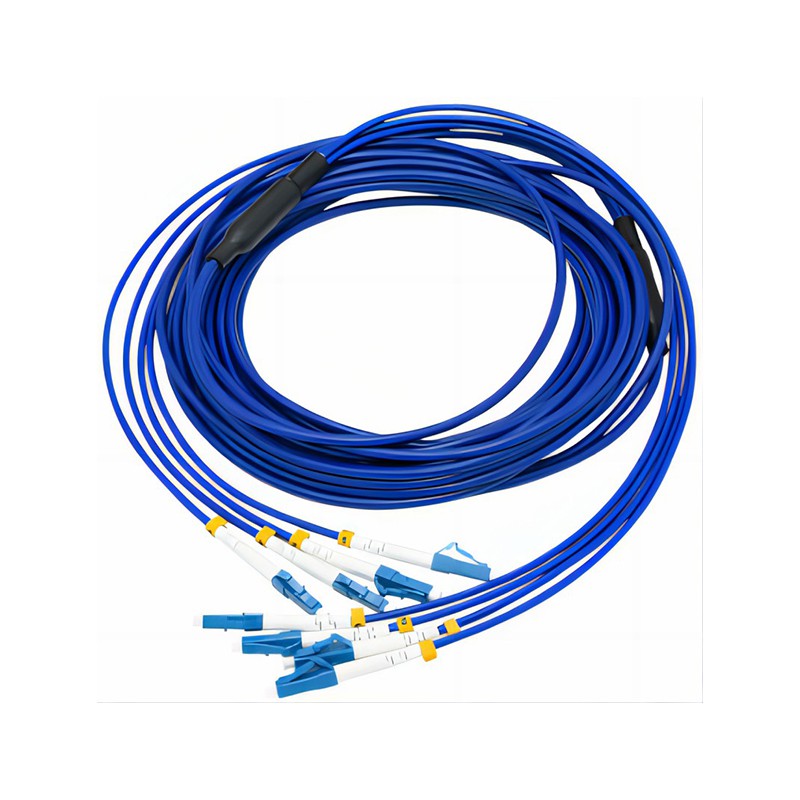
Let's say you're setting up a monitoring system in an electrical substation. You need to transfer data from sensors to a control room. Using a copper cable in this high - voltage environment would be a nightmare. You'd have to deal with all the electrical interference, and you'd probably end up with a lot of inaccurate data. But if you use a fiber optic cable assembly, like the LC to LC Multi - Fiber Optic Jumper Cable, you can rest assured that your data will be transmitted accurately and reliably.
Another great thing about fiber optic cables is their insulation properties. The outer protective layers of the cable assembly provide an extra layer of protection against high - voltage electrical fields. These layers are designed to prevent any electrical charges from reaching the fiber optic core. So, even if there's a high - voltage source nearby, the cable can still function properly.
But it's not all sunshine and rainbows. There are a few things you need to keep in mind when using fiber optic cable assemblies in high - voltage environments.
One of the main concerns is the installation. You have to make sure that the cables are installed correctly. If the cables are damaged during installation, it can affect their performance. For example, if the outer protective layer is scratched or punctured, it might not provide adequate protection against high - voltage fields. So, it's important to use trained professionals for the installation.
You also need to think about the temperature. High - voltage environments can get pretty hot, especially in places like power plants. Fiber optic cables have a certain temperature range within which they can operate effectively. If the temperature goes beyond this range, it can cause the cable to expand or contract, which can lead to signal loss. So, you might need to use special cables that are designed to withstand high temperatures.

Maintenance is another important aspect. Regular inspections are a must. You need to check for any signs of damage, like cracks in the outer layer or breaks in the fiber optic core. If you find any issues, you should replace the cable assembly as soon as possible.
In some high - voltage environments, there might be the risk of lightning strikes. Although fiber optic cables are non - conductive, a lightning strike can still cause problems. The sudden surge of electrical energy can create a strong electromagnetic field, which can induce currents in nearby metal components of the cable assembly, like the connectors. To prevent this, you can use lightning protection devices.
Overall, fiber optic cable assemblies are a great choice for high - voltage environments. They offer reliable data transmission, immunity to EMI and RFI, and good insulation properties. With proper installation, temperature management, and maintenance, they can work effectively in these challenging conditions.
If you're in the market for fiber optic cable assemblies for your high - voltage project, I'd love to have a chat with you. Whether you need the SC To SC Duplex Cable Assembly, the SC to SC Duplex Fiber Optic Jumper Cable, or the LC to LC Multi - Fiber Optic Jumper Cable, we've got you covered. Contact us to discuss your specific requirements and let's find the best solution for your project.
References:
- Textbooks on fiber optics and electrical engineering
- Industry reports on the use of fiber optic cables in high - voltage environments