

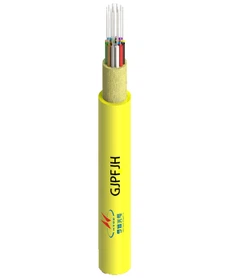




GYDTA53 is an outdoor, stranded loose-tube ribbon fiber optic cable designed for high fiber counts in a protected cable structure. Optical fiber ribbons are housed in filled loose tubes around a central strength member. Aluminum tape, a polyethylene (PE) inner sheath, steel tape armor and a PE outer sheath protect the cable core. The published range covers 12 to 576 fibers, with typical cable outside diameters from 19.5 to 25.6 mm. Published applications are duct routes and non-self-supporting aerial routes; the final construction must be confirmed against the project specification.
Product model: GYDTA53
Cable construction: Stranded loose tubes containing optical fiber ribbons
Protection: Aluminum tape, PE inner sheath, steel tape and PE outer sheath
Published fiber count: 12–576 fibers
Fiber options listed: G.652 and G.655
Published applications: Duct and non-self-supporting aerial installation
Standard delivery length: 2,000 m per drum; other lengths available on request
GYDTA53 Cable Construction

Ribbon-containing loose tubes are stranded around a central strength member, with filler rods used where required by the design. Tube filling compound protects the ribbons, while cable filling compound helps limit longitudinal moisture movement. The assembled core is wrapped with aluminum tape and covered by an inner PE sheath. Steel tape is then applied outside the inner sheath, followed by the PE outer sheath. This model differs from single-jacket ribbon cable designs; selection should follow the route, mechanical requirements and installation method.
Fiber ribbon: Organizes multiple fibers in ribbon form for high-count cable configurations and compatible mass-fusion workflows.
Central strength member: Supports the stranded cable core and contributes to tensile-load management.
Tube filling compound: Helps protect the ribbon fibers from moisture inside each loose tube.
Filler rod: Maintains the intended core geometry where a tube position is not occupied.
Loose tube: Houses the optical fiber ribbons and provides space for fiber management.
Aluminum tape: Forms a moisture-resistant layer around the assembled cable core.
Inner sheath: PE layer separating and protecting the inner cable structure.
Steel tape: Provides an additional mechanical-protection layer around the inner sheath.
Cable filling compound: Helps limit water migration through spaces in the cable core.
Outer sheath: PE layer protecting the cable in an outdoor installation environment.
Key Features of GYDTA53 Ribbon Cable
Ribbon construction for high fiber counts: Ribbon fibers organize a large number of fibers within one cable. Confirm the fibers-per-ribbon arrangement and compatibility with splice trays, holders and fusion-splicing equipment.
Moisture-protection layers: Aluminum tape, tube filling compound and cable filling compound work together to protect the cable core. Project water-penetration acceptance criteria should be stated in the specification.
Double PE sheath and steel tape: The two PE sheaths and steel tape add mechanical protection. Use the published tensile and crush values below instead of relying on the phrase "double armored" alone.
GYDTA53 Technical Specifications
| Fiber Count | Cable OD (mm) | Cable Weight (kg/km) | Tensile Long / Short Term (N) | Crush Long / Short Term (N/100 mm) | Dynamic Bend Radius | Static Bend Radius |
| 12–192 | 19.5 | 341 | 1000 / 3000 | 1000 / 3000 | 25D | 12.5D |
| 204–288 | 20.3 | 369 | 1000 / 3000 | 1000 / 3000 | 25D | 12.5D |
| 300–384 | 23.0 | 465 | 1000 / 3000 | 1000 / 3000 | 25D | 12.5D |
| 396–576 | 25.6 | 581 | 1000 / 3000 | 1000 / 3000 | 25D | 12.5D |
How to read bend radius: D is the cable outside diameter. A value of 25D means 25 times the cable outside diameter, not 25 mm.
Value status: The figures are typical published values and may vary with the final order configuration.
Project review: Long-term and short-term ratings are separate. Confirm the final cable datasheet and acceptance limits before ordering.
Optical Fiber Transmission Performance
| Fiber Type | Wavelength (nm) | Maximum Attenuation (dB/km) | Typical Attenuation (dB/km) |
| G.652 | 1310 | 0.36 | 0.35 |
| G.652 | 1550 | 0.22 | 0.21 |
| G.655 | 1550 | 0.22 | 0.21 |
| G.655 | 1625 | 0.26 | 0.24 |
Fiber selection: Specify the fiber category and wavelength requirements for the planned transmission system.
Testing: Fiber attenuation and cable mechanical properties are separate checks. Review both when defining fiber optic cable testing and acceptance requirements.
Transport and storage: Published temperature range: -40°C to +70°C. Confirm a separate operating-temperature rating for the intended installation.
Applications and Installation Review
Outdoor duct installation: For a duct fiber optic cable route, check the duct inside diameter, selected cable OD, pulling conditions and the minimum dynamic bend radius. Suitability cannot be established from fiber count alone.
Non-self-supporting aerial installation: The published applications include non-self-supporting aerial routes. GYDTA53 is not an all-dielectric self-supporting cable. Evaluate the support system, installation tension, span conditions and accessories.
Direct burial requires confirmation: The published application list does not explicitly include direct burial. Confirm site conditions, required protection and an approved specification before specifying direct-buried use.
GYDTA53 vs. GYTA53
| Selection Point | GYDTA53 | GYTA53 |
| Fiber arrangement | Optical fiber ribbons inside loose tubes | Individual optical fibers inside loose tubes |
| Published Hengtong fiber count | 12–576 fibers | Check the separate model-specific GYTA53 specification |
| Splicing consideration | Ribbon organization and compatible mass-fusion preparation | Individual-fiber identification and single-fiber splicing workflow |
| Selection priority | High-count ribbon organization and ribbon-based splicing plan | Individual-fiber loose-tube construction and its own mechanical specification |
Selection note: GYDTA53 uses ribbon fibers, while the Hengtong GYTA53 armored loose-tube cable uses individual fibers. Do not select either model from the cable code alone.
Before ordering: Confirm the exact fiber count, installation method, final cable OD, mechanical ratings and splice plan.
Ordering Information and Customization
Required fiber count: State the number of fibers and planned spare capacity.
Fiber type: Specify the required G.652 or G.655 option and optical parameters.
Ribbon configuration: Confirm fibers per ribbon, ribbon grouping and splice-equipment compatibility.
Installation method: Identify duct or non-self-supporting aerial installation; submit any other proposed method for engineering confirmation.
Route conditions: Include duct dimensions, bends, installation clearance and expected mechanical exposure.
Mechanical requirements: State project tensile, crush and bend-radius limits.
Delivery requirements: Provide total quantity, preferred drum lengths, destination and required schedule.
Marking and documents: State cable marking, company identification, test documents and project-specific requirements.
GYDTA53 Frequently Asked Questions
Buyer Questions Answered
Q: How many fibers are available in GYDTA53 cable?
A: The published GYDTA53 specifications cover 12 to 576 fibers in four cable-diameter groups. Confirm the final fiber count and ribbon arrangement in the order.
Q: Can GYDTA53 ribbon fibers be mass-fusion spliced?
A: Ribbon construction can support mass-fusion splicing when the ribbon format, preparation method, holders and fusion splicer are compatible. Confirm the fibers-per-ribbon configuration for the supplied cable.
Q: Is GYDTA53 suitable for direct burial?
A: The published applications are duct and non-self-supporting aerial installation. Direct burial is not explicitly listed. Request confirmation of direct-burial suitability and supporting product data before specifying it.
Q: What is the difference between GYDTA53 and GYTA53?
A: GYDTA53 contains optical fiber ribbons within the loose tubes. The referenced GYTA53 product uses individual optical fibers in loose tubes. This affects fiber organization and splicing workflow; each model also has its own dimensions and mechanical specification.
Q: Can cable length and marking be customized?
A: The published standard length is 2,000 m, with other lengths available on request. Company information or logos can be printed on the cable when agreed as part of the order.
Request GYDTA53 Specifications and a Quotation
Provide the required fiber count, fiber type, installation method, route conditions, total quantity and preferred drum length. Include ribbon-splicing requirements and project-specific mechanical or optical acceptance criteria so the proposed cable can be checked against the specification.
Request GYDTA53 Specifications and Quotation
Hot Tags: GYDTA53 fiber optic cable, GYDTA53 ribbon cable, double armored ribbon fiber optic cable, double jacket ribbon fiber optic cable, armored ribbon fiber cable, high fiber count ribbon cable, outdoor ribbon fiber optic cable


