





Fiber optic jumpers play a crucial role in modern communication networks, serving as the vital link that connects various network devices. As a leading supplier of fiber optic jumpers, I often encounter inquiries about the attenuation of these essential components. In this blog, I aim to provide a comprehensive understanding of what attenuation is, its causes, and its impact on fiber optic jumper performance.
What is Attenuation in Fiber Optic Jumpers?
Attenuation, in the context of fiber optic jumpers, refers to the reduction in the intensity of light as it travels through the fiber. It is measured in decibels per kilometer (dB/km) and is a critical parameter that determines the maximum distance over which a fiber optic link can operate effectively. The lower the attenuation, the less signal loss occurs, and the longer the fiber can transmit data without significant degradation.
Causes of Attenuation in Fiber Optic Jumpers
There are several factors that contribute to attenuation in fiber optic jumpers, including:
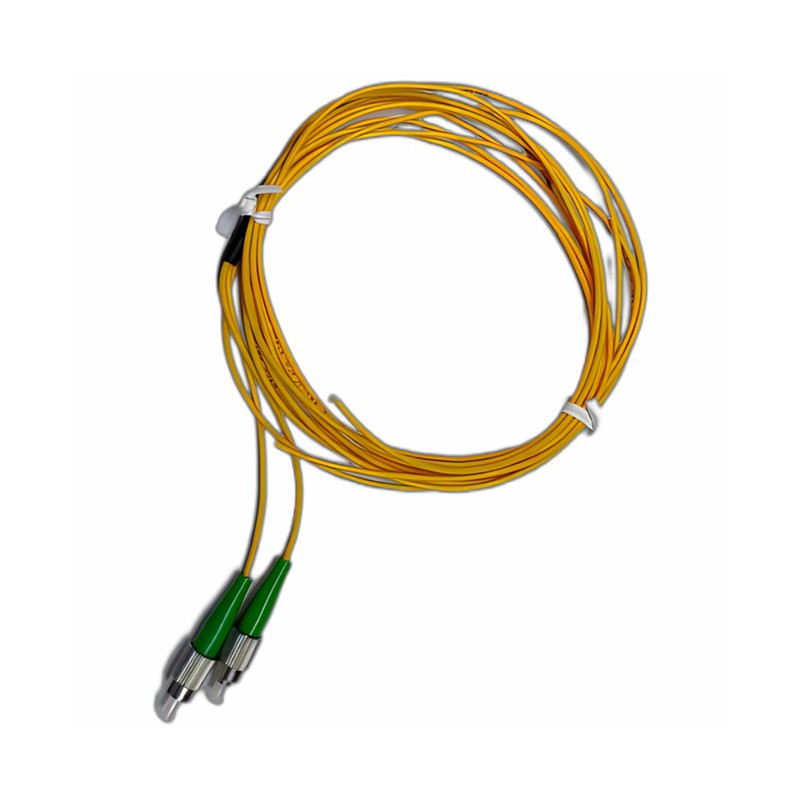

Intrinsic Factors
- Material Absorption: The glass material used in fiber optic cables absorbs a portion of the light energy as it travels through the fiber. This absorption is primarily due to impurities and molecular vibrations within the glass. Different wavelengths of light are absorbed to varying degrees, with certain wavelengths experiencing higher absorption rates. For example, infrared light at 1310 nm and 1550 nm is commonly used in fiber optic communication because it has lower absorption rates compared to other wavelengths.
- Rayleigh Scattering: Rayleigh scattering is another intrinsic factor that causes attenuation in fiber optic cables. It occurs when light interacts with small inhomogeneities in the glass material, such as density fluctuations and molecular impurities. These inhomogeneities scatter the light in different directions, causing a portion of the light energy to be lost. Rayleigh scattering is inversely proportional to the fourth power of the wavelength, which means that shorter wavelengths are more susceptible to scattering than longer wavelengths.
Extrinsic Factors
- Bending Losses: Bending the fiber optic cable can cause significant attenuation, especially if the bend radius is too small. When the fiber is bent, the light rays inside the fiber may escape from the core and into the cladding, resulting in signal loss. There are two types of bending losses: macro - bending and micro - bending. Macro - bending occurs when the fiber is bent with a large radius, such as when the cable is routed around corners. Micro - bending, on the other hand, is caused by small - scale deformations in the fiber, such as those resulting from improper cable installation or mechanical stress.
- Connector Losses: Fiber optic connectors are used to join fiber optic jumpers to other network devices. However, these connectors can introduce attenuation due to factors such as misalignment, dirt, and scratches. When the cores of two fibers are not perfectly aligned within the connector, a portion of the light may not be transmitted from one fiber to the other, resulting in signal loss. Additionally, dirt and scratches on the connector end - faces can also cause light to scatter and be absorbed, further increasing attenuation.
Impact of Attenuation on Fiber Optic Jumper Performance
The attenuation of fiber optic jumpers has a direct impact on the performance of fiber optic communication networks. High attenuation levels can lead to several problems, including:
- Reduced Transmission Distance: As the attenuation increases, the signal strength decreases more rapidly over distance. This means that the maximum distance over which data can be transmitted without significant degradation is reduced. In long - haul fiber optic networks, even a small increase in attenuation can require the installation of additional repeaters or amplifiers to boost the signal strength, which increases the cost and complexity of the network.
- Lower Data Rates: Attenuation can also affect the data rate that can be achieved over a fiber optic link. When the signal strength is low, the receiver may have difficulty distinguishing between different data symbols, leading to errors in data transmission. To compensate for this, the data rate may need to be reduced to ensure reliable communication.
Measuring Attenuation in Fiber Optic Jumpers
To ensure the quality and performance of fiber optic jumpers, it is essential to measure their attenuation accurately. There are several methods for measuring attenuation, including:
- Cut - Back Method: This is a laboratory - based method that involves cutting a known length of fiber from the end of the cable and measuring the optical power at the input and output of the remaining fiber. The attenuation is then calculated based on the difference in power and the length of the fiber. The cut - back method provides highly accurate results but is destructive and time - consuming, making it unsuitable for field testing.
- Insertion Loss Method: The insertion loss method is a non - destructive way to measure attenuation in fiber optic jumpers. It involves measuring the optical power before and after inserting the jumper into a test setup. The difference in power is then used to calculate the attenuation of the jumper. This method is commonly used in field testing and is relatively quick and easy to perform.
Controlling Attenuation in Fiber Optic Jumpers
As a fiber optic jumper supplier, we take several measures to control and minimize attenuation in our products:
- High - Quality Materials: We use high - purity glass materials with low levels of impurities to reduce absorption losses. By carefully selecting the raw materials, we can ensure that our fiber optic jumpers have low attenuation characteristics.
- Precision Manufacturing: Our manufacturing process is designed to minimize bending losses and connector losses. We use advanced manufacturing techniques to ensure that the fiber optic cables are properly fabricated and that the connectors are precisely aligned and polished. This helps to reduce signal loss and improve the overall performance of our jumpers.
- Quality Testing: Every fiber optic jumper undergoes rigorous quality testing to ensure that it meets our strict attenuation specifications. We use state - of - the - art testing equipment to measure the attenuation of each jumper at multiple wavelengths and under different conditions. Only jumpers that pass our quality tests are released for sale.
Our Product Range
We offer a wide range of fiber optic jumpers to meet the diverse needs of our customers. Some of our popular products include:
- FC Duplex Pigtail: These pigtails are designed for use in applications where high - performance and reliability are required. They feature FC connectors, which provide a secure and stable connection.
- SC To SC Fiber Optic Jumper: SC connectors are widely used in fiber optic networks due to their ease of use and low insertion loss. Our SC to SC fiber optic jumpers are available in various lengths and configurations to suit different applications.
- SC Duplex Pigtail: These pigtails are ideal for applications where space is limited. They feature SC connectors and are available in both single - mode and multi - mode versions.
Contact Us for Procurement
If you are in the market for high - quality fiber optic jumpers with low attenuation, we would be delighted to assist you. Our team of experts can provide you with detailed product information, technical support, and competitive pricing. Whether you need a small quantity of jumpers for a specific project or a large - scale supply for your network infrastructure, we have the capabilities to meet your requirements. Please feel free to contact us to discuss your procurement needs and start a productive business relationship.
References
- Ghatak, Ajoy K., and K. Thyagarajan. "Optical Electronics in Modern Communications." Cambridge University Press, 2008.
- Senior, John M. "Optical Fiber Communications: Principles and Practice." Pearson Education, 2012.
- ITU - T G.652. "Characteristics of a single - mode optical fibre cable." International Telecommunication Union, 2016.