



As a supplier of underground fibre optic cables, I've been deeply involved in the world of optical communication. One of the critical phenomena that we often encounter and need to understand is Polarization Mode Dispersion (PMD). In this blog, I'll delve into what PMD is, its implications for underground fibre optic cables, and how our products are designed to address it.
Understanding Polarization Mode Dispersion
Polarization Mode Dispersion is a form of signal distortion that occurs in single - mode optical fibres. To understand PMD, we first need to know a bit about the polarization of light. In an ideal single - mode fibre, light can propagate in two orthogonal polarization modes, which can be thought of as two different "channels" for the light to travel. These two polarization modes should, in theory, travel at the same speed through the fibre.
However, in real - world scenarios, imperfections in the fibre's manufacturing process, mechanical stress, and environmental factors can cause the two polarization modes to travel at different speeds. This difference in propagation speed between the two polarization modes is what we call Polarization Mode Dispersion.
Mathematically, PMD is usually measured in picoseconds per square root of kilometre (ps/√km). It is a statistical parameter because the exact amount of PMD can vary along the length of the fibre and over time due to changes in environmental conditions.
Causes of PMD in Underground Fibre Optic Cables
There are several factors that contribute to PMD in underground fibre optic cables.
Manufacturing Imperfections
During the manufacturing process of the fibre, it is almost impossible to achieve a perfectly symmetric structure. Even the slightest deviation from perfect circular symmetry in the fibre's core can cause birefringence, which is the property that leads to different propagation speeds for the two polarization modes. For example, small variations in the refractive index distribution within the core can result in PMD.
Mechanical Stress
Underground fibre optic cables are often subject to various mechanical stresses. They may be buried in soil, which can exert pressure on the cable. Construction activities near the cable route can also cause bending, twisting, or compression of the cable. These mechanical stresses can change the shape of the fibre, inducing birefringence and increasing PMD. For instance, if a cable is bent too sharply during installation, it can cause a significant increase in PMD in that section of the fibre.
Environmental Factors
The underground environment is not static. Temperature variations, humidity, and soil movement can all affect the performance of the fibre optic cable. Temperature changes can cause the fibre to expand or contract, which in turn can alter the refractive index and the shape of the fibre, leading to changes in PMD. Humidity can also have an impact, as moisture can penetrate the cable and affect the properties of the fibre and its coating.
Implications of PMD for Underground Fibre Optic Cables
PMD can have significant implications for the performance of underground fibre optic cables, especially in high - speed communication systems.
Signal Degradation
As the two polarization modes travel at different speeds, the optical signal becomes spread out in time. This spreading can cause inter - symbol interference (ISI), where the symbols in the digital signal start to overlap with each other. ISI can lead to errors in data transmission, reducing the signal quality and the overall reliability of the communication system.

Limitation on Transmission Distance and Speed
In high - speed optical communication systems, PMD can limit the maximum transmission distance and data rate. As the data rate increases, the time interval between symbols becomes shorter. With PMD causing the signal to spread out, the probability of ISI increases. To maintain a low error rate, the transmission distance may need to be reduced. For example, in a 40 Gbps system, PMD can become a major limiting factor compared to a 10 Gbps system.
How Our Underground Fibre Optic Cables Address PMD
As a supplier of underground fibre optic cables, we are well aware of the challenges posed by PMD. We have taken several measures to minimize PMD in our products.
Advanced Manufacturing Techniques
We use state - of - the - art manufacturing processes to ensure the highest level of symmetry in the fibre's core. By carefully controlling the deposition of materials during the fibre - drawing process, we can reduce the birefringence caused by manufacturing imperfections. Our quality control systems also continuously monitor the PMD levels during production to ensure that our fibres meet strict standards.
Cable Design
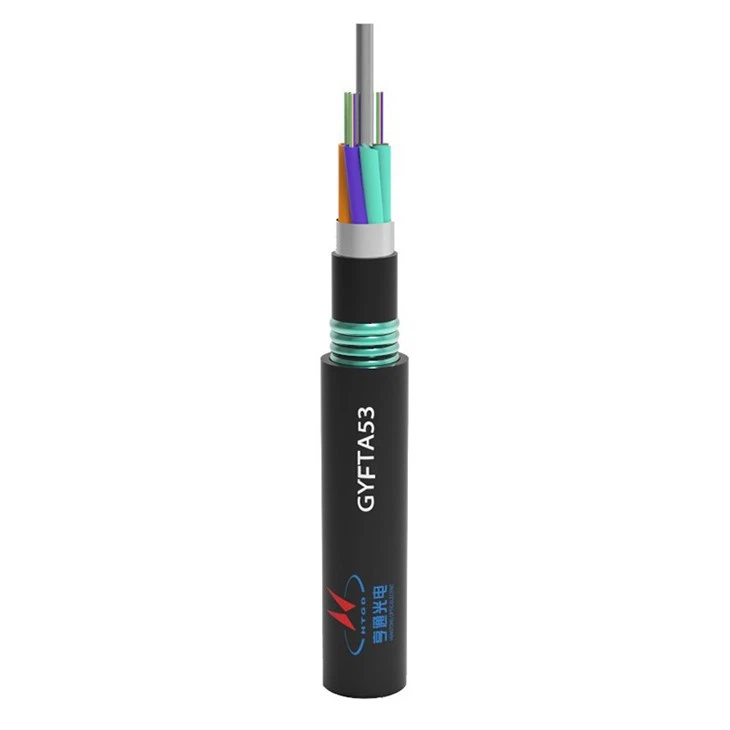
Our cable designs are optimized to protect the fibre from mechanical stress. For example, we offer the Multi Tube Double Jacket and Armored Direct Buried Cable. This cable has multiple tubes that house the fibres, providing an extra layer of protection. The double jacket and armor further shield the cable from external pressure, bending, and impact, reducing the likelihood of mechanical stress - induced PMD.
The Non Metallic Double Jacket Cable is another option. It is designed to be lightweight and flexible while still providing excellent protection against environmental factors. The non - metallic construction also reduces the risk of electromagnetic interference, which can sometimes exacerbate PMD.
Our FRP Strength Member Multitube Single Jacket Duct Cable uses Fiber Reinforced Plastic (FRP) as a strength member. FRP provides high strength and flexibility, which helps to maintain the integrity of the fibre under mechanical stress and reduces PMD.
Environmental Adaptability
We also take into account the environmental factors when designing our cables. Our cables are engineered to withstand a wide range of temperatures and humidity levels. Special coatings and materials are used to prevent moisture ingress and protect the fibre from the effects of temperature changes. This helps to keep the PMD levels stable over time and in different underground environments.
Conclusion
Polarization Mode Dispersion is a critical issue in underground fibre optic cables. It can cause signal degradation and limit the performance of high - speed communication systems. However, through advanced manufacturing techniques, innovative cable designs, and a focus on environmental adaptability, we are able to minimize the impact of PMD in our products.
If you are in need of high - quality underground fibre optic cables that can effectively address PMD and other challenges, we invite you to contact us for a detailed discussion. Our team of experts is ready to provide you with the best solutions for your specific requirements.
References
- Agrawal, G. P. (2002). Fiber - optic communication systems. Wiley.
- Senior, J. M. (1992). Optical fiber communications: principles and practice. Prentice Hall.
- Jeunhomme, L. B. (1990). Single - mode fiber optics: principles and applications. Marcel Dekker.