





Optical fiber technology has revolutionized the way local area networks (LANs) operate. As an optical fiber supplier, I have witnessed firsthand the numerous applications and benefits that optical fiber brings to LANs. In this blog post, I will explore the various applications of optical fiber in local area networks, highlighting its advantages and how it can enhance network performance.
High - Speed Data Transmission
One of the most significant applications of optical fiber in LANs is high - speed data transmission. In today's digital age, businesses and organizations rely heavily on fast and reliable data transfer to operate efficiently. Optical fiber can support extremely high data rates, far exceeding those of traditional copper cables. For instance, modern optical fiber networks can transmit data at speeds of up to 100 Gbps or even higher, which is crucial for applications such as large - scale data transfers, high - definition video streaming, and real - time data analytics.
The use of optical fiber for high - speed data transmission in LANs ensures that employees can access and share information quickly, improving productivity. For example, in a large corporate office, departments can transfer large files, such as design blueprints or high - resolution videos, in a matter of seconds, rather than waiting minutes or hours as they might with copper - based networks. This speed also enables seamless collaboration between teams, as real - time data can be shared without any significant lag.
Long - Distance Connectivity
Another important application of optical fiber in LANs is its ability to provide long - distance connectivity. Unlike copper cables, which suffer from signal attenuation over long distances, optical fiber can transmit signals over much greater lengths without significant loss of quality. This makes it ideal for connecting different buildings within a campus - style LAN or for linking remote offices within a company.
For example, a university campus may have multiple buildings spread over a large area. By using optical fiber, the IT department can connect all the buildings into a single LAN, ensuring that students and faculty have access to a unified network infrastructure. Similarly, a company with offices in different parts of a city can use optical fiber to create a wide - area LAN, allowing for seamless communication and data sharing between the offices.
Immunity to Electromagnetic Interference
Optical fiber is immune to electromagnetic interference (EMI) and radio - frequency interference (RFI). In a typical office environment, there are numerous sources of EMI and RFI, such as electrical motors, fluorescent lights, and wireless devices. Copper cables are highly susceptible to these interferences, which can degrade the quality of the transmitted signal and lead to data errors.
In a LAN that uses optical fiber, the network is more reliable and less prone to disruptions caused by EMI and RFI. This is particularly important for industries that rely on sensitive data transmission, such as finance and healthcare. For example, in a bank's LAN, optical fiber ensures that financial transactions are processed accurately and securely, without any interference that could lead to errors or security breaches.
Security
Security is a major concern for any LAN. Optical fiber offers enhanced security compared to copper cables. Since optical fiber transmits data in the form of light signals, it is much more difficult to tap into the cable without being detected. In contrast, copper cables can be easily intercepted, as the electrical signals can be picked up using simple equipment.

In a corporate LAN, where sensitive business information is transmitted, the use of optical fiber provides an added layer of security. For example, in a company that deals with trade secrets or customer data, optical fiber ensures that the data remains confidential and protected from unauthorized access.
Applications in Specific LAN Environments
Data Centers
Data centers are at the heart of modern LANs, storing and processing vast amounts of data. Optical fiber is widely used in data centers for its high - speed data transmission capabilities. It is used to connect servers, storage systems, and network switches, enabling fast and efficient data transfer within the data center.
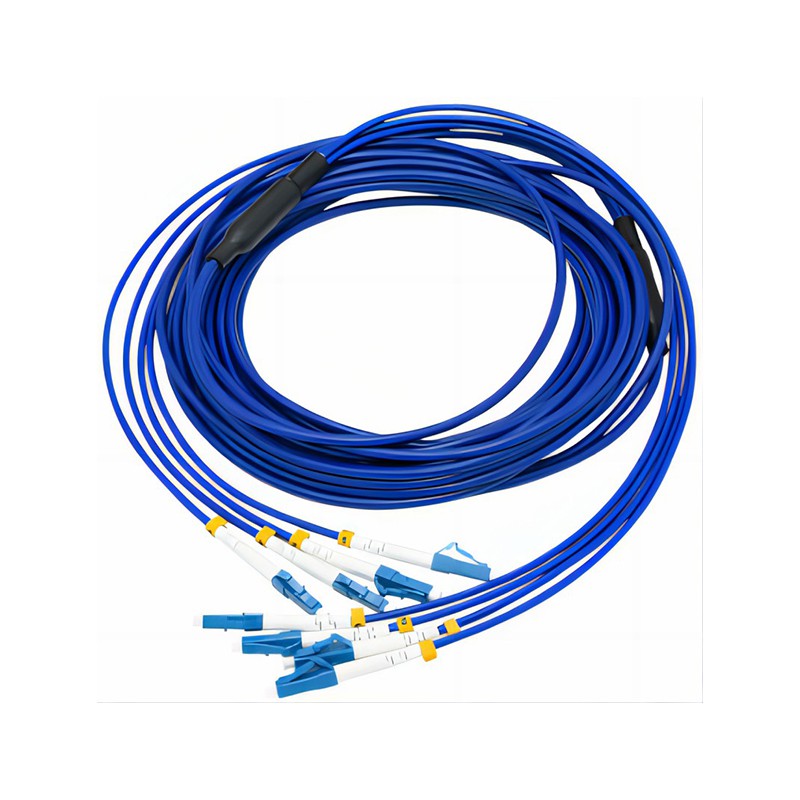
For example, in a large - scale data center, optical fiber cables such as LC to LC Multi - Fiber Optic Jumper Cable are used to connect multiple servers in a rack to a network switch. These cables provide high - density connectivity, allowing for a large number of connections in a small space.
Residential LANs
With the increasing demand for high - speed internet and home entertainment, optical fiber is also making its way into residential LANs. Service providers are now offering fiber - to - the - home (FTTH) solutions, which use optical fiber to connect homes directly to the internet service provider's network.
In a residential LAN, optical fiber can provide high - speed internet access for multiple devices, such as smartphones, tablets, smart TVs, and gaming consoles. For example, the FTTH Drop Cable Patch Cord LC To LC Duplex can be used to connect the optical fiber coming into the home to the home router, ensuring a fast and stable internet connection.
Industrial LANs
Industrial environments often require robust and reliable LANs to support automation, control systems, and real - time monitoring. Optical fiber is well - suited for industrial LANs due to its immunity to EMI and RFI, as well as its ability to withstand harsh environmental conditions.
In a factory setting, for example, optical fiber can be used to connect different manufacturing equipment, sensors, and control panels. The Self - supporting Butterfly Lead - in Fiber Optical Cable is a type of optical fiber cable that is commonly used in industrial LANs, as it can be easily installed and is designed to withstand mechanical stress and temperature variations.
Conclusion
Optical fiber has a wide range of applications in local area networks, offering high - speed data transmission, long - distance connectivity, immunity to electromagnetic interference, and enhanced security. Whether it is in a corporate office, a university campus, a data center, a residential home, or an industrial environment, optical fiber can significantly improve the performance and reliability of LANs.
As an optical fiber supplier, I am committed to providing high - quality optical fiber products and solutions to meet the diverse needs of LANs. If you are interested in upgrading your LAN to optical fiber or have any questions about our products, please do not hesitate to contact us for a detailed discussion and procurement negotiation. We look forward to working with you to build a more efficient and reliable LAN infrastructure.
References
- "Fiber Optics for Local Area Networks." IEEE Communications Magazine, Volume 27, Issue 9, September 1989.
- Stallings, W. (2017). Data and Computer Communications. Pearson.
- Gerd Keiser. (2013). Optical Fiber Communications. McGraw - Hill Education.